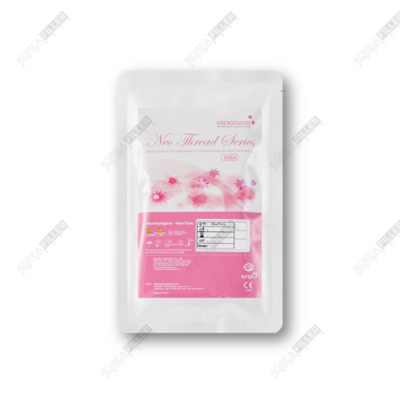
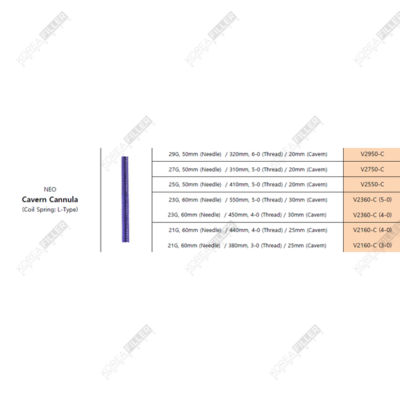

NEO Cavern Cannula (Coil Spring: L-Type)
Polydioxanone (PDO) coil-spring thread · up to 550 mm of filament through a 50–60 mm blunt cannula. 10 pieces per pack.
$138.90
You save
Neo Cavern Thread PDO is a polydioxanone threads used for the elimination of the different types of wrinkles on face and neck as well as volumarization. Polydioxanone (PDO) is a flexible polymer, which remains intact in the injection point up to 6 months. Threads created based on PDO exhibit multiple effects: their subcutaneous injection initiates skin self-regeneration by increasing collagen synthesis and improving blood microcirculation. As a result of the application of polydioxanone threads the significant lifting effect is observed accompanied by wrinkles elimination, small skin imperfections diminishment, as well as elasticity improvement.
Types example :
| Model Code | Needle Size | Needle Length | Threads Length | USP |
| M3112 | 31G | 12mm | 16mm | 7-0 |
Professional use only. This product is intended for administration by licensed healthcare practitioners trained in the relevant anatomy and injection technique. By ordering you confirm you are authorised to purchase and handle products of this class in your jurisdiction. Availability and permitted use vary by country — please verify local regulations before ordering.
Did you like this product? Add to favorites now and follow the product.

(+82) 10 7364 7998 Send a message on WhatsApp.
Up to 550 mm of PDO compressed into a 60 mm cannula
NEO Cavern Cannula carries a specification that looks like a misprint until you understand the design: a 60 mm cannula delivering 550 mm of thread. Nearly ten times the filament length of the track it travels.
It is not a misprint. The filament is wound into a tight coil spring, compressed inside the cannula, and released into tissue where it relaxes into its coiled form. A single placement therefore deposits several times more polydioxanone than any straight or lightly coiled thread of the same cannula length — by a wide margin, the highest material-per-insertion ratio in the NEO range.
It is still a smooth thread. No barbs, no mechanical anchoring. What you are buying is concentration of collagen stimulus, not lift and not volume.
A 60 mm cannula carrying 550 mm of thread. The highest material-per-insertion ratio in the range, by a long way.
A blunt tip displaces vessels rather than cutting them — important when placing this much material.
21G down to 29G, with filament lengths chosen alongside gauge rather than simply scaling with it.
PDO breaks down over roughly six months. The collagen formed around the coil persists longer.
Why practitioners stock NEO Cavern Cannula
310 to 550 mm of filament through a single short track. Nothing else here concentrates material to this degree.
Bruising scales with the number of entries far more than with material delivered. Consolidating this much filament into one pass is the practical argument for the format.
Every size is a blunt L-type cannula, including the fine 29G option — vessels are displaced rather than cut at every gauge.
The 21G sizes offer 380 mm or 440 mm at the same cannula length, so you can select material load separately from bore.
Treatment areas
Areas where concentrated coil-spring placement is used. All are density applications in tissue able to accommodate a substantial coil — smooth filaments cannot reposition tissue or add filler-like volume.
Pronounced nasolabial and labiomental folds, where concentrated collagen stimulus along one track is the aim and the surrounding tissue is deep enough to carry the coil.
Substantial midface tissue where several hundred millimetres of filament can sit without showing. Pinch-test before choosing this over a lighter thread.
Horizontal neck lines treated with the finer 27G and 29G options, which carry lower filament loads better suited to thin skin while keeping the blunt-cannula advantage.
Not an anatomical indication, but a real reason to choose this format. Delivering a given quantity of PDO through one blunt pass rather than many sharp ones is the most effective way to reduce visible downtime.
PDO threads are sterile implantable medical devices. Which applications are permitted, and what training is required, is determined by the regulatory framework where you practise. Korea Filler Experts supplies the product; nothing here is a recommendation to treat any medical condition, and nothing here substitutes for hands-on training in cannula and thread technique.
Available sizes and specifications
| V2160-C (3-0) | 21G · 60 mm cannula · 380 mm thread · USP 3-0 — 6.3× ratio |
| V2160-C (4-0) | 21G · 60 mm cannula · 440 mm thread · USP 4-0 — 7.3× ratio |
| V2360-C (4-0) | 23G · 60 mm cannula · 450 mm thread · USP 4-0 — 7.5× ratio |
| V2360-C (5-0) | 23G · 60 mm cannula · 550 mm thread · USP 5-0 — 9.2× ratio |
| V2550-C | 25G · 50 mm cannula · 410 mm thread · USP 5-0 — 8.2× ratio |
| V2750-C | 27G · 50 mm cannula · 310 mm thread · USP 5-0 — 6.2× ratio |
| V2950-C | 29G · 50 mm cannula · 320 mm thread · USP 6-0 — 6.4× ratio |
| Material | Polydioxanone (PDO) |
| Structure | Compressed coil spring |
| Thread surface | Smooth — no barbs or cogs |
| Delivery | Blunt-tipped L-type cannula |
| Pack size | 10 pieces per pack |
| Storage | Room temperature, dry, away from sunlight |
Checking the pack
- The model code including the USP suffix matches your order. V2160-C and V2360-C each exist in two versions carrying different filament loads — the suffix is the only thing distinguishing them.
- Each blister is intact and dry. A breached sterile barrier makes that unit waste.
- The expiry date is clear. PDO hydrolyses with moisture.
- The pack holds 10 pieces.
Entry needles are required and not supplied. A blunt cannula cannot make its own entry port.
What each component does
Why the thread is ten times longer than the cannula
Every other thread in this range carries a filament slightly longer than its needle — a 60 mm needle holding 90 mm of thread, so the filament extends past the tip and stays behind on withdrawal. A 1.5× ratio.
This product runs at 6× to 9×. The filament is wound into a tight coil spring and held compressed inside the cannula. On deposition it relaxes into its coiled form, occupying the track as a spring rather than a line.
The consequence is simply quantity. V2360-C (5-0) deposits 550 mm of PDO where a mono thread at a comparable cannula length would deposit 90 mm — about six times the material, in one pass, through one entry point.
The ratio is not uniform — choose deliberately
Material load does not scale neatly with gauge, so the codes are worth reading carefully:
- Both 21G options share a 60 mm cannula but carry 380 mm or 440 mm, at USP 3-0 and 4-0 respectively — heavier filament, less length.
- The 23G pair runs 450 mm at 4-0 or 550 mm at 5-0, the highest load in the range.
- The 27G option carries 310 mm, less than the 29G at 320 mm despite the heavier bore.
So a finer gauge does not reliably mean less material. Read the filament length, not just the gauge.
Reading the specifications
- 21G to 29G — cannula diameter; higher number means thinner.
- Thread length — the total filament deposited, not the distance travelled.
- USP 3-0 to 6-0 — filament thickness on the standard suture scale, where more zeros means thinner.
How to use NEO Cavern Cannula
Reference information for practitioners trained in cannula technique. This product deposits several times more material per placement than anything else in the range, so placement count and tissue assessment both need rethinking rather than carrying over from other threads.
Step by step
-
Check the filament load on the code
Confirm which version you have before planning. V2360-C (5-0) carries 550 mm; V2750-C carries 310 mm. That is nearly double the material from products that look similar on the shelf.
-
Assess tissue thickness
Several hundred millimetres of coiled filament occupies real space. If you cannot comfortably pinch a fold over the intended track, choose a lighter product.
-
Plan very few placements
Mark entry points with the patient upright. One Cavern placement may deliver what five or six mono threads would — plan from material load rather than from habit.
-
Prepare and anaesthetise
Thorough antisepsis — this is an implant. Local anaesthetic at entry points; topical alone is insufficient at 21G to 25G.
-
Create the entry port
Make the entry with a sharp needle sized for the cannula to pass without forcing.
-
Advance in the subcutaneous plane
Advance along the marked track at consistent depth, deeper than you would place a single-filament thread. A coil spring that relaxes too superficially will be palpable.
-
Deposit evenly and palpate
Withdraw steadily so the coil distributes along the track rather than bunching at the far end. Palpate the full length before moving on — bunched coil is easier to address now than at review.
Administration notes
Withdraw at an even pace. This is the technique point specific to this product. Several hundred millimetres of compressed filament released too quickly, or with a stalled withdrawal, can concentrate at one point in the track instead of distributing along it. Even deposition is what you are controlling.
Recalibrate your placement count. Practitioners coming from mono or twin threads routinely over-place here. One Cavern placement may carry the material of five or six mono threads — treat it as a different unit, not a heavier version of the same thing.
- Single use. Never re-sterilise or reuse a cannula or thread.
- Do not place across active infection, inflamed skin, or recently placed filler.
- Do not attempt to withdraw and reposition a partially deposited coil — it will not re-compress.
- Dispose of entry needles into a sharps container per local clinical waste requirements.
After treatment
- Swelling, bruising and tenderness are expected and may take seven to ten days to settle
- Avoid vigorous facial massage and extreme expression for about two weeks
- No saunas, steam rooms or strenuous exercise for 48 hours
- Sleep on the back where practical for the first week
- Defer dental work and facial treatments for two weeks
- A palpable lump that is not settling by two weeks, or any spreading redness or discharge, needs reviewing
Storing and handling NEO Cavern Cannula
Store at room temperature in a dry place, away from direct sunlight. No refrigeration and no cold chain.
Each unit is individually sealed and sterile. Do not use any whose blister is open, torn, damp or damaged. Never re-sterilise — autoclaving destroys PDO.
The filament is held compressed inside the cannula. Do not attempt to withdraw, inspect or re-load it — once released it will not re-compress, and that unit is spent.
Single use only. Do not reuse, re-sterilise or repackage. Dispose of used cannulas and entry needles into a sharps container, and unused product as clinical waste in line with local requirements.
What's included
Check the USP suffix when ordering — V2160-C and V2360-C each exist in two versions carrying different filament loads. Entry needles are required and not supplied; antiseptic, local anaesthetic and sharps disposal are also not included.
NEO Cavern Cannula — frequently asked questions
Is the thread length really 550 mm on a 60 mm cannula?
Yes — it is not a typo, and it is the whole point of the product.
The filament is wound into a tight coil spring and held compressed inside the cannula. Released into tissue it relaxes into its coiled form, so a single short track receives several hundred millimetres of PDO. Every other thread in the range runs at about 1.5× filament-to-needle length; this one runs at six to nine times.
What does that extra material actually achieve?
More collagen stimulus per insertion, and fewer insertions for a given total. Since bruising scales with the number of entries far more than with the material delivered, concentrating the load into one pass is the practical benefit.
It does not change the mechanism — just how much of it happens per placement.
Does it restore volume?
No, and the earlier version of this listing was misleading on that. A dermal filler occupies space on the day it is injected; a PDO coil does not, and is gone within about six months.
What builds is dermal density through the patient’s own collagen response, over six to eight weeks. Real, but different in both kind and timescale from a filler.
Will it lift sagging cheeks?
No. The filament is smooth, so there is nothing to grip or reposition tissue with — however much of it you place.
Improving skin density can make a contour look better, but it is not repositioning. For descent you need a barbed thread: our Cog Cannula or Combi Cog.
Why does a 27G option carry less thread than a 29G one?
Because filament load is specified independently of gauge rather than scaling with it. V2750-C at 27G carries 310 mm; V2950-C at 29G carries 320 mm.
The practical lesson is to read the filament length rather than inferring it from bore. The same applies to the 21G and 23G pairs, where the USP suffix distinguishes two quite different loads at the same cannula size.
How many placements does an area need?
Far fewer than with conventional threads, and this is where practitioners most often over-treat. One Cavern placement may deliver the material of five or six mono threads.
Treat it as a different unit rather than a heavier version of the same thing, and plan from material load rather than habit.
Can I reposition it if the first pass is wrong?
No. Once the coil begins to deposit it will not re-compress into the cannula. Plan the track before you start, because you are committed from the moment deposition begins.
How long does the effect last?
The PDO hydrolyses over roughly six months. The collagen formed around the coil persists beyond that, so the clinical effect outlasts the material. Review at six to nine months and plan from what you see.
Do they need refrigeration?
No. Room temperature, dry, out of direct sunlight — no cold chain to manage.
Who can buy and use these?
Threads are sterile implantable medical devices. This format requires confident cannula technique and controlled withdrawal, since even deposition of a compressed coil is the skill it demands. We supply to practitioners qualified to perform the procedure in their jurisdiction, and do not sell to consumers.

Copyright 2026 © Korea Filler Experts. All right reserved.
