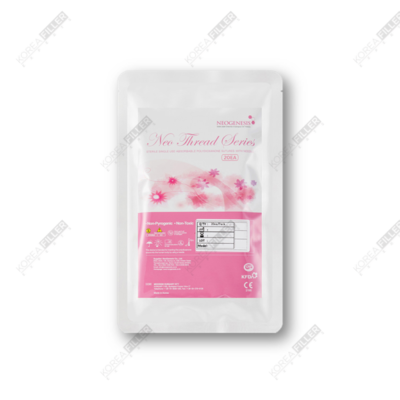

NEO Multi Thread : Tornado Screw (Two Twisted Screw)
Polydioxanone (PDO) screw thread · two filaments twisted around the needle · 23G to 27G. 20 pieces per pack.
$48.90
Neo Multi Thread Tornado Screw PDO is a polydioxanone threads based on two twisted around needle filaments used for the thread lifting of face and body. Tornado Screw threads is a model of non-classical threads based on two twisted around needle filaments for elimination of wrinkles and revitalization of face and body skin.
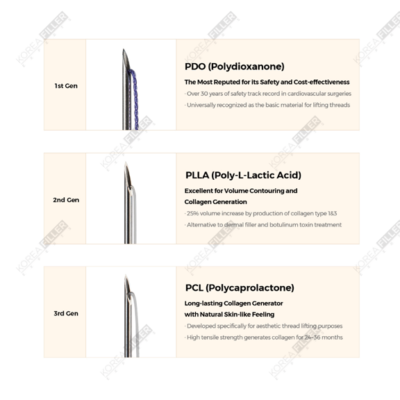
Polydioxanone (PDO) is a flexible polymer, which remains intact in the injection point up to 6 months. Threads created based on PDO exhibit multiple effects: their subcutaneous injection initiates skin self-regeneration by increasing collagen synthesis and improving blood microcirculation. As a result of the application of polydioxanone threads the significant lifting effect is observed accompanied by wrinkles elimination, small skin imperfections diminishment, as well as elasticity improvement.
Types example :
| Model Code | Needle Size | Needle Length | Threads Length | USP |
| M3112 | 31G | 12mm | 16mm | 7-0 |
- Sourced through licensed Korean distribution channels
- Temperature-controlled handling from our facility to your door
- Batch number and expiry visible before dispatch
- Practitioner support from our team
Professional use only. This product is intended for administration by licensed healthcare practitioners trained in the relevant anatomy and injection technique. By ordering you confirm you are authorised to purchase and handle products of this class in your jurisdiction. Availability and permitted use vary by country — please verify local regulations before ordering.
Did you like this product? Add to favorites now and follow the product.

(+82) 10 7364 7998 Send a message on WhatsApp.
Two PDO filaments twisted into a spiral
NEO Tornado Screw is a smooth PDO thread with a difference in geometry rather than surface: two filaments twisted together in a spiral around the needle, instead of a single straight strand.
The twist does two things. It puts roughly twice the PDO into a single track, so the collagen stimulus along that track is correspondingly greater than a mono thread would deliver. And the spiral shape distributes that material in three dimensions rather than along a straight line, which practitioners use to build density in areas where a flat mesh of mono threads under-delivers.
It does not lift. The filaments are smooth — there are no barbs, cogs or anchoring features — so like every smooth thread it improves skin quality rather than skin position. The twist increases the stimulus; it does not add grip.
Two filaments where a mono thread places one, so the collagen stimulus along the track is greater.
The twist distributes material in three dimensions rather than along a flat line.
23G to 27G, needles from 38 mm to 90 mm, matched to zone and tissue depth.
No barbs. Greater stimulus than a mono thread, but no mechanical lift — the twist adds volume of material, not grip.
Why practitioners stock NEO Tornado Screw
Two twisted filaments deliver roughly double the PDO of a mono thread through the same single pass — useful where a flat mono mesh has under-delivered.
The spiral spreads material through the tissue column rather than along one plane, which suits areas needing depth of density rather than surface coverage.
23G through 27G, needle lengths from 38 mm to 90 mm, so one product covers periorbital through to neck and body work.
More material than a mono thread, considerably less than a barbed thread — a sensible middle option for density-focused treatment.
Treatment areas
Areas commonly treated with twisted PDO threads. All are skin-density applications — smooth filaments cannot reposition tissue, however they are arranged.
Building dermal thickness where skin has thinned, using fewer passes than a mono mesh would need. The 25G and 26G sizes at 50–60 mm cover this zone.
Increasing tissue density along a fold to soften its appearance. Worth stating clearly at consultation that this softens rather than erases, and over weeks rather than immediately.
Crepey texture and loss of density, where the 90 mm needles cover more ground per insertion. Thin skin here needs deeper placement than the face — a twisted thread shows more readily than a mono one.
Areas of thin or lax skin on the body, where the 23G gauge has the rigidity to pass through denser tissue. Skin quality work rather than contouring — threads do not reshape body contour.
PDO threads are sterile implantable medical devices. Which applications are permitted, and what training is required, is determined by the regulatory framework where you practise. Korea Filler Experts supplies the product; nothing here is a recommendation to treat any condition, and nothing here substitutes for hands-on training in thread technique.
Available sizes and specifications
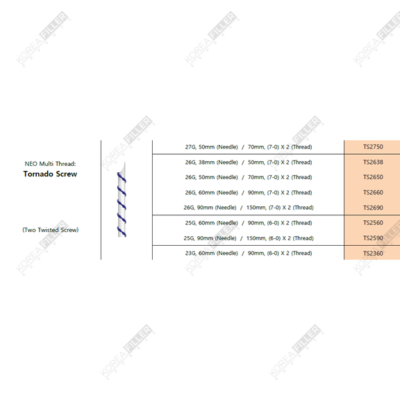
| TS2360 | 23G · 60 mm needle · 90 mm thread · USP 6-0 × 2 strands |
| TS2560 | 25G · 60 mm needle · 90 mm thread · USP 6-0 × 2 strands |
| TS2590 | 25G · 90 mm needle · 150 mm thread · USP 6-0 × 2 strands |
| TS2638 | 26G · 38 mm needle · 50 mm thread · USP 7-0 × 2 strands |
| TS2650 | 26G · 50 mm needle · 70 mm thread · USP 7-0 × 2 strands |
| TS2660 | 26G · 60 mm needle · 90 mm thread · USP 7-0 × 2 strands |
| TS2690 | 26G · 90 mm needle · 150 mm thread · USP 7-0 × 2 strands |
| TS2750 | 27G · 50 mm needle · 70 mm thread · USP 7-0 × 2 strands |
| Material | Polydioxanone (PDO) |
| Configuration | Two filaments twisted in a spiral |
| Thread surface | Smooth — no barbs or cogs |
| Delivery | Pre-loaded in a sharp hypodermic needle |
| Pack size | 20 pieces per pack |
| Sterilisation | Sterile, single use only |
| Storage | Room temperature, dry, away from sunlight |
Checking the pack
- The model code matches your order — TS2638, TS2650, TS2660 and TS2690 differ only in needle length.
- Each blister is intact and dry. A breached sterile barrier makes that unit waste.
- The expiry date is clear. PDO hydrolyses with moisture.
- The pack holds 20 pieces.
The twist is pre-formed. Do not attempt to straighten, re-twist or separate the filaments — the spiral is the product, and disturbing it loses you what you are paying for.
What each component does
Where screw threads sit in the range
Smooth PDO threads vary by how many filaments they carry and how those filaments are arranged. All of them stimulate collagen; none of them lift.
- Mono — one straight filament. The baseline, and the cheapest way to build a mesh.
- Screw — one filament coiled around the needle. More material and a spiral distribution, in a single strand.
- Tornado Screw (this product) — two filaments twisted together in a spiral. Roughly double the material of a mono thread, distributed three-dimensionally.
- Twin and Triple — two or three filaments laid together without the spiral twist.
- Thread Filler — twenty fine filaments through a blunt cannula. The densest smooth option.
Choosing between them is a question of how much stimulus you want in one track and how you want it distributed. None of these is a step toward lifting — that is a separate category of product entirely.
Reading the specifications
- 23G to 27G — needle diameter; higher number means thinner.
- Needle vs thread length — the filaments always extend beyond the needle so they stay in tissue as it withdraws. A 60 mm needle carries 90 mm of thread.
- USP 6-0 and 7-0 × 2 — each of the two filaments is that thickness on the standard suture scale, where more zeros means thinner. Two 7-0 strands together are still fine; their advantage is combined material and geometry, not bulk.
How to use NEO Tornado Screw threads
Reference information for trained practitioners. Thread insertion requires specific training in facial anatomy and technique; this is not a procedure to attempt from a product page.
Step by step
-
Plan placement with the patient upright
Mark the treatment zone before the patient lies down. Screw threads are usually placed more sparsely than mono threads, because each delivers more material — plan accordingly rather than defaulting to a dense mono-style mesh.
-
Prepare the field
Cleanse and disinfect thoroughly. Threads are implanted and remain in situ for months, so antisepsis matters more than for an injectable that disperses.
-
Anaesthetise as needed
Topical is usually sufficient at 26G and 27G; the heavier 23G and 25G gauges may warrant local at entry points.
-
Insert along the planned track
Enter at a shallow angle and advance in the correct plane — dermal or immediately subdermal depending on zone. A twisted thread occupies more space than a mono, so err deeper rather than shallower.
-
Withdraw the needle, leave the thread
Hold the thread hub steady and withdraw the needle along the same track. The twisted filaments stay behind, retaining their spiral.
-
Trim and palpate
Trim any protruding thread flush at skin level, then palpate for ridging or tenting before the next pass.
Administration notes
Place fewer than you would mono threads. Each Tornado Screw delivers roughly double the PDO of a mono thread in a three-dimensional distribution, so a mono-density mesh of screw threads over-treats the area. Practitioners moving from mono to screw commonly over-place on the first few cases.
Go slightly deeper than with mono threads. A twisted thread has more bulk, so the depth that sits invisibly for a single filament may show as a ridge for a spiral pair.
- Single use. Never re-sterilise or reuse a thread or its needle.
- Do not place across active infection, inflamed skin, or recently placed filler.
- Keep clear of major vessels and nerves — a sharp needle gives no tactile warning.
- Dispose of needles into a sharps container per local clinical waste requirements.
After treatment
- Mild bruising, swelling and tenderness along the tracks are expected and usually settle within a week
- Avoid extreme facial expression and vigorous massage for about two weeks
- No saunas, steam rooms or strenuous exercise for 48 hours
- Sleep on the back where practical for the first few nights
- Defer dental work and facial treatments for two weeks
- Any spreading redness, increasing pain or discharge needs reviewing promptly
Storing and handling NEO Tornado Screw threads
Store at room temperature in a dry place, away from direct sunlight. No refrigeration and no cold chain.
Each thread is individually sealed and sterile. Do not use any unit whose blister is open, torn, damp or damaged. Never re-sterilise — autoclaving destroys PDO.
The spiral is formed during manufacture. Do not straighten, re-twist or separate the filaments — a disturbed twist no longer distributes material as designed.
Single use only. Do not reuse, re-sterilise or repackage. Dispose of used needles into a sharps container and unused product as clinical waste in line with local requirements.
What's included
Each pack contains one size only — threads are not mixed within a pack. Antiseptic, anaesthetic, marking pen and sharps disposal are not supplied.
NEO Tornado Screw — frequently asked questions
What is a Tornado Screw thread?
Two polydioxanone filaments twisted together in a spiral around the needle, rather than one straight strand. Both filaments are smooth — there are no barbs.
What does the twist actually achieve?
Two things. It puts roughly twice the PDO into one track, so the collagen stimulus is greater than a mono thread delivers. And it distributes that material through the tissue column in three dimensions rather than along a flat line.
What it does not do is add grip. The surface is still smooth.
Will it lift?
No. Smooth filaments have nothing to engage tissue with, however they are arranged. Twisting two of them together increases the amount of material and changes its distribution — it does not create an anchoring mechanism.
For repositioning you need a barbed thread: our Cog Cannula or Combi Cog. Marketing in this category frequently describes screw threads as “lifting” threads. They are not.
How does it compare to a mono thread?
Same material, same smooth surface, same mechanism — about twice the material per insertion, distributed spirally rather than linearly.
Mono threads are cheaper and better for building a fine, even mesh. Screw threads suit areas where you want more stimulus from fewer passes, or where a flat mono mesh has under-delivered.
How does it differ from your Twin thread?
Twin carries two filaments laid alongside each other; Tornado Screw twists its two into a spiral. Same filament count, different geometry — the twist distributes material through the tissue column rather than along a plane.
Which suits better is a technique preference rather than a clear hierarchy.
Should I place as many as I would mono threads?
No — fewer. Each screw thread delivers roughly double the material of a mono thread, so a mono-density mesh over-treats the area. Over-placement is the most common error when practitioners move from mono to screw.
Which size should I choose?
Match needle to tissue. The 26G and 27G short needles suit finer facial skin; 25G at 60 mm and 90 mm covers larger facial zones and the neck; 23G is for denser tissue and body work where a fine needle would deflect.
How long does the effect last?
The PDO hydrolyses over roughly six months. The collagen laid down around it persists beyond that, so the clinical effect outlasts the material.
Duration varies by patient, density and skin condition. Most clinics review at six to nine months and plan from what they see rather than promising a fixed figure.
Do they need refrigeration?
No. Room temperature, dry, out of direct sunlight — no cold chain to manage, which makes threads much simpler to stock than injectables.
Who can buy and use these?
Threads are sterile implantable medical devices for use by trained healthcare professionals. Insertion requires specific training in facial anatomy and thread technique. We supply to practitioners qualified to perform the procedure in their jurisdiction, and do not sell to consumers.

Copyright 2026 © Korea Filler Experts. All right reserved.
