NEO Thread: Mono Single Thread
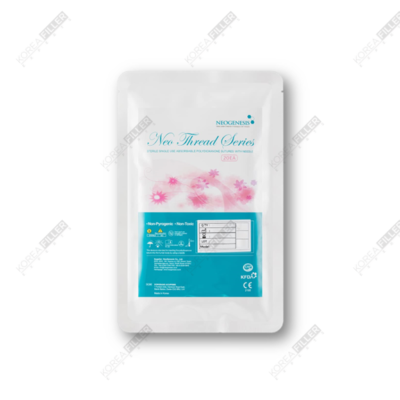
Polydioxanone (PDO) mono thread · 23G to 31G · single smooth filament, pre-loaded on needle. 20 pieces per pack. MFDS certified, CE marked.
$24.90
You save
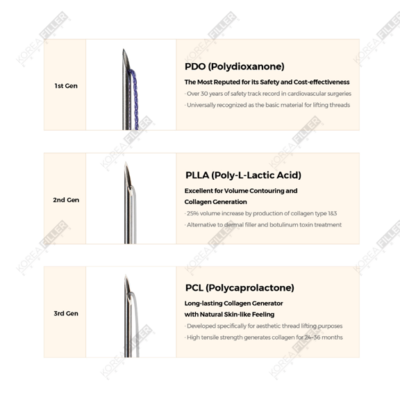
Neo Thread Mono PDO is a polydioxanone threads used for the thread lifting of face and neck. Polydioxanone (PDO) is a flexible polymer, which remains intact in the injection point up to 6 months. Threads created based on PDO exhibit multiple effects: their subcutaneous injection initiates skin self-regeneration by increasing collagen synthesis and improving blood microcirculation. As a result of the application of polydioxanone threads the significant lifting effect is observed accompanied by wrinkles elimination, small skin imperfections diminishment, as well as elasticity improvement.
– KFDA Certified
– CE Approved
Types example :
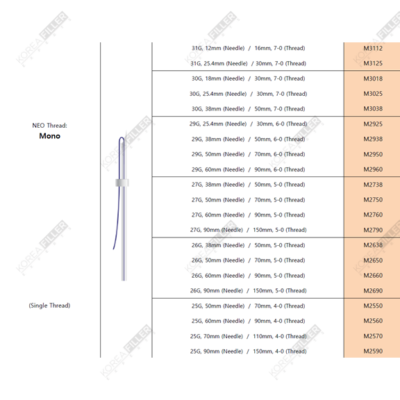
| Model Code | Needle Size | Needle Length | Threads Length | USP |
| M3112 | 31G | 12mm | 16mm | 7-0 |
Professional use only. This product is intended for administration by licensed healthcare practitioners trained in the relevant anatomy and injection technique. By ordering you confirm you are authorised to purchase and handle products of this class in your jurisdiction. Availability and permitted use vary by country — please verify local regulations before ordering.
Did you like this product? Add to favorites now and follow the product.

(+82) 10 7364 7998 Send a message on WhatsApp.
A single smooth PDO filament for collagen stimulation
NEO Mono Single Thread is the simplest product in the thread category: one smooth polydioxanone filament, pre-loaded in a hypodermic needle, inserted into the dermis or subcutaneous plane and left in place as the needle is withdrawn.
It is worth being clear about what a mono thread does. It has no barbs, cogs or anchoring features, so it cannot reposition tissue — a mono thread does not lift. What it does is act as a controlled foreign body: the PDO filament provokes a measured healing response, and new collagen is laid down along its track before the thread itself hydrolyses away. The result practitioners describe is firmer, denser skin rather than repositioned skin.
That distinction decides whether this is the right product. A patient with good skin quality and jowling needs a cog thread. A patient with crepey, thinning skin and no significant descent is exactly who mono threads are for — and at this price point, they can be placed in quantity.
A smooth filament with no barbs. It densifies skin along its track; it does not reposition tissue.
From 23G × 60 mm down to 31G × 12 mm, so the same product covers neck, cheek and periorbital work.
Mono threads are placed in numbers — typically 10 to 30 per area — so pack size matters more here than elsewhere.
PDO breaks down over roughly six months. The collagen laid down around it persists longer.
Why practitioners stock NEO Mono threads
Twenty-three combinations of gauge, needle length and filament thickness — from 31G × 12 mm for fine periorbital work up to 23G × 60 mm for the neck.
The least expensive product in the range, which matters because mono threads are placed in quantity rather than singly.
Linear insertion with no anchoring, no vector planning and no tissue gathering. The usual entry point for a practitioner new to threads.
Korean regulatory certification plus a CE mark. Confirm what applies in your own market before ordering.
Treatment areas
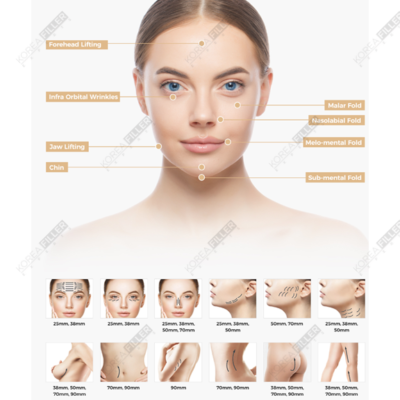
Areas commonly treated with PDO mono threads. All of these are skin-quality applications — none involves repositioning tissue, because a smooth thread cannot do that.
A cross-hatch mesh placed across the cheek to increase dermal density where skin has thinned. The most common single use for this product, and the one the 27G–29G sizes are built around.
Horizontal neck lines and crepey texture, where longer 25G and 26G needles cover more ground per pass. Thin skin here needs careful depth control — superficial placement shows.
Fine lines around the eyes and mouth, treated with the 30G and 31G short needles. Very superficial work in thin skin, where the smallest gauges exist precisely for this.
Placed in combination with barbed threads — the cogs reposition, the mono mesh improves the quality of the skin being repositioned. A common pairing in full thread-lift protocols.
PDO threads are sterile implantable medical devices. Which applications are permitted, and what training is required, is determined by the regulatory framework where you practise. Korea Filler Experts supplies the product; nothing here is a recommendation to treat any medical condition, and nothing here substitutes for hands-on training in thread technique.
Available sizes and specifications
| M2360 | 23G · 60 mm needle · 90 mm thread · USP 3-0 |
| M2390 | 23G · 90 mm needle · 150 mm thread · USP 3-0 |
| M2550 | 25G · 50 mm needle · 70 mm thread · USP 4-0 |
| M2560 | 25G · 60 mm needle · 90 mm thread · USP 4-0 |
| M2570 | 25G · 70 mm needle · 110 mm thread · USP 4-0 |
| M2590 | 25G · 90 mm needle · 150 mm thread · USP 4-0 |
| M2638 | 26G · 38 mm needle · 50 mm thread · USP 5-0 |
| M2650 | 26G · 50 mm needle · 70 mm thread · USP 5-0 |
| M2660 | 26G · 60 mm needle · 90 mm thread · USP 5-0 |
| M2690 | 26G · 90 mm needle · 150 mm thread · USP 5-0 |
| M2738 | 27G · 38 mm needle · 50 mm thread · USP 5-0 |
| M2750 | 27G · 50 mm needle · 70 mm thread · USP 5-0 |
| M2760 | 27G · 60 mm needle · 90 mm thread · USP 5-0 |
| M2790 | 27G · 90 mm needle · 150 mm thread · USP 5-0 |
| M2925 | 29G · 25.4 mm needle · 30 mm thread · USP 6-0 |
| M2938 | 29G · 38 mm needle · 50 mm thread · USP 6-0 |
| M2950 | 29G · 50 mm needle · 70 mm thread · USP 6-0 |
| M2960 | 29G · 60 mm needle · 90 mm thread · USP 6-0 |
| M3018 | 30G · 18 mm needle · 30 mm thread · USP 7-0 |
| M3025 | 30G · 25.4 mm needle · 30 mm thread · USP 7-0 |
| M3038 | 30G · 38 mm needle · 50 mm thread · USP 7-0 |
| M3112 | 31G · 12 mm needle · 16 mm thread · USP 7-0 |
| M3125 | 31G · 25.4 mm needle · 30 mm thread · USP 7-0 |
| Material | Polydioxanone (PDO) |
| Delivery | Pre-loaded in a sharp hypodermic needle |
| Pack size | 20 pieces per pack |
| Sterilisation | Sterile, single use only |
| Certification | MFDS certified, CE marked |
Checking the pack
- The model code on the pack matches what you ordered — M2638 and M2738 differ by one digit and one needle gauge.
- Each blister is intact. A breached sterile barrier means that thread is waste, not a judgement call.
- The expiry date is clear. PDO is hydrolysed by moisture, so shelf life is real rather than nominal.
- The pack holds 20 pieces.
Storage is simple here. Unlike botulinum toxin, threads need no refrigeration and no cold chain — room temperature, dry, out of direct sunlight.
What each component does
How to read these specifications
Three numbers describe every thread, and two of them run in opposite directions — which catches people out.
- Gauge (23G–31G) — the needle diameter. Higher number means thinner. A 31G needle is much finer than a 23G one. Thinner means less trauma and less bruising, but also less rigidity, so fine needles are harder to pass through dense tissue.
- Needle length vs thread length — the thread is always longer than the needle it sits in. A 60 mm needle carries a 90 mm filament, because the thread has to extend beyond the needle tip to stay in the tissue as the needle withdraws.
- USP size (2-0 to 7-0) — the filament’s own thickness, using the standard suture scale. More zeros means thinner. A 7-0 thread is far finer than a 3-0. On the USP scale for synthetic absorbable sutures that is roughly 0.05–0.07 mm at 7-0 and 0.20–0.25 mm at 3-0.
Choosing a size
- 31G and 30G, short needles — periorbital skin, fine perioral lines. Minimal trauma, very superficial placement.
- 29G and 27G, medium — cheek, temple and general facial skin quality work. The most commonly used band.
- 26G and 25G, longer — neck and jawline, where longer passes cover more area per insertion.
- 23G, 60–90 mm — body work and thicker tissue, where a finer needle would deflect.
How to use NEO Mono threads
Reference information for trained practitioners. Thread insertion requires specific training in facial anatomy and in the technique itself; this is not a procedure to attempt from a product page.
Step by step
-
Plan the mesh
Mono threads work cumulatively, so plan a pattern rather than individual placements — commonly a cross-hatch or fan covering the whole treatment zone. Mark it with the patient upright before they lie down.
-
Prepare the field
Cleanse and disinfect thoroughly. Threads are implanted and remain in situ for months, so antisepsis matters more than for an injectable that disperses.
-
Anaesthetise as needed
Topical anaesthetic is usually sufficient for fine gauges; entry points for longer needles may warrant a small amount of local.
-
Insert along the planned vector
Enter at a shallow angle, then advance in the correct plane — dermal or immediately subdermal depending on the zone. The thread should not be visible or palpable as a ridge once placed.
-
Withdraw the needle, leave the thread
Hold the thread hub steady and withdraw the needle along the same track. The filament stays behind.
-
Trim and check
Trim any protruding thread flush at skin level. Palpate the area for ridging or tenting before moving to the next pass.
Administration notes
How many threads? Mono threads are a volume product by design. Practitioners commonly place somewhere between 10 and 30 in a single zone to build a supportive mesh — which is why a 20-piece pack is a sensible unit and why cost per thread matters more here than on a cog product.
What this product will not do. If a patient’s concern is jowling, descent or a lost jawline, mono threads are the wrong tool and no quantity of them will fix it. That requires a barbed thread — our Cog Cannula or Combi Cog — or a different modality entirely. Setting this expectation at consultation is the difference between a satisfied patient and a refund request.
- Single use. Never re-sterilise or reuse a thread or its needle.
- Avoid placing threads across an active infection, inflamed skin or an area of recent filler.
- Keep clear of major vessels and nerves; blunt dissection is not available to you with a sharp needle.
- Dispose of needles into a sharps container in line with local clinical waste requirements.
After treatment
- Mild bruising, swelling and tenderness along the insertion tracks are expected and usually settle within a week
- Advise the patient to avoid extreme facial expression and vigorous massage for about two weeks
- No saunas, steam rooms or strenuous exercise for 48 hours
- Sleep on the back where practical for the first few nights
- Dental work and facial treatments are best deferred for two weeks
- Any spreading redness, increasing pain or discharge needs reviewing promptly rather than reassuring over the phone
Storing and handling NEO Mono threads
Store at room temperature in a dry place, away from direct sunlight. No refrigeration and no cold chain — a practical advantage over injectables if your fridge space is tight.
Each thread is individually sealed and sterile. Do not use any unit whose blister is open, torn, damp or damaged. Do not re-sterilise — PDO degrades by hydrolysis and autoclaving destroys it.
Use before the printed expiry. PDO hydrolyses in the presence of moisture, so an expired thread may have lost tensile strength even if it looks intact.
Single use only. Do not reuse, re-sterilise or repackage. Dispose of used needles into a sharps container and unused product as clinical waste in line with local requirements.
What's included
Each pack contains one size only — threads are not mixed within a pack. If you want a range of gauges for different zones, order the sizes separately. Antiseptic, anaesthetic, marking pen and sharps disposal are not supplied.
NEO Mono Single Thread — frequently asked questions
What is a mono thread?
A single smooth filament of polydioxanone, pre-loaded in a hypodermic needle. It is inserted into the skin and left in place as the needle is withdrawn. There are no barbs or cogs — the surface is smooth along its entire length.
Will mono threads lift my patient's face?
No, and this is the most important thing to know about them. A smooth thread has nothing to grip tissue with, so it cannot reposition anything.
What it does is stimulate collagen along its track, which firms and thickens skin over the following weeks. If the clinical problem is descent — jowls, a lost jawline — you need a barbed thread such as our Cog Cannula or Combi Cog. A lot of marketing in this category blurs that line; we would rather be straight with you about it.
So what are mono threads actually good for?
Skin quality rather than skin position. Crepey texture, thinning skin, fine lines, loss of density across the cheek, neck or décolletage — areas where the skin itself has become thin rather than fallen.
They are also used as a supporting mesh alongside barbed threads in a combination treatment.
How many threads does a treatment need?
Mono threads work cumulatively, so they are placed in numbers. Ten to thirty per zone is a common range, depending on the area and how dense a mesh you want. That is why they come in packs of twenty and why cost per thread matters here.
Which gauge should I choose?
Match the needle to the tissue. Fine gauges — 30G and 31G, short needles — for periorbital and perioral skin. The 27G to 29G band covers most general facial work. Heavier 25G and 26G with longer needles suit the neck and jawline, and 23G is for body work or dense tissue where a fine needle would deflect.
What does "USP 5-0" mean?
It is the filament’s own thickness on the standard suture scale, and it runs backwards from what you might expect: more zeros means thinner. A 7-0 thread is much finer than a 3-0.
It is a separate measurement from the needle gauge. A fine needle carries a fine thread, so the two generally track together.
How long do they last?
The PDO itself hydrolyses over roughly six months. The collagen response it provokes is laid down in the first weeks and persists beyond the thread’s own lifespan, so the clinical effect outlasts the material.
How long that effect holds varies by patient, treatment density and skin condition. Most clinics review at six to nine months and plan repeat treatment from there rather than promising a fixed duration.
Do they need refrigeration?
No. Room temperature, dry, out of direct sunlight. There is no cold chain to manage, which makes threads considerably easier to stock than injectables.
Can a thread be removed if there is a problem?
A superficially placed mono thread that is visible or palpable can sometimes be retrieved shortly after placement, but this is not reliably possible and becomes harder as tissue reaction sets in.
The practical safeguard is placement depth. A thread placed at the correct plane should be neither visible nor palpable — if it is, the plane was too superficial.
Who can buy and use these?
Threads are sterile implantable medical devices for use by trained healthcare professionals. Insertion requires specific training in facial anatomy and in thread technique. We supply to practitioners qualified to perform the procedure in their jurisdiction, and do not sell to consumers.

Copyright 2026 © Korea Filler Experts. All right reserved.
