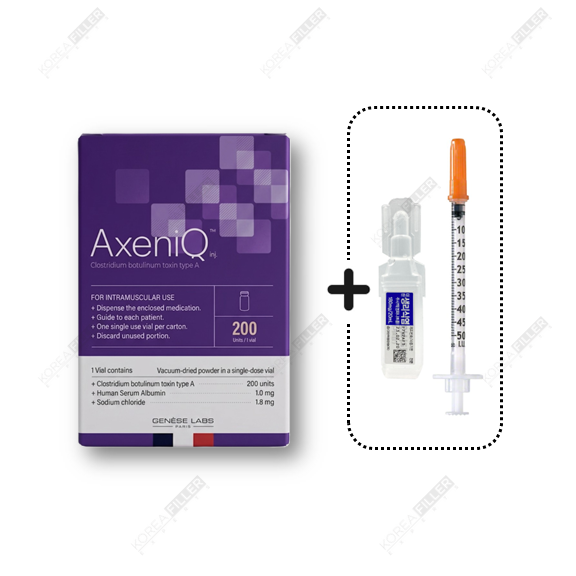
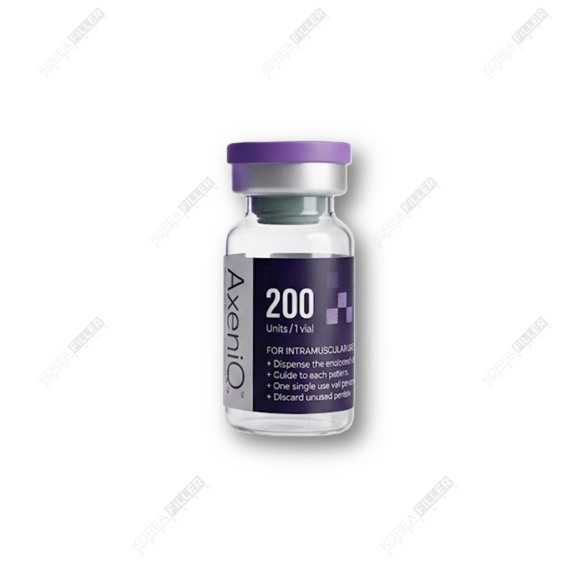
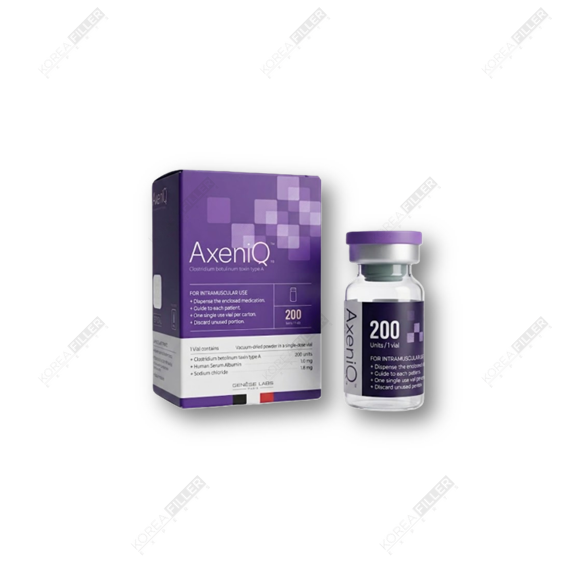
AxeniQ 200UI
Clostridium botulinum toxin type A · 200 units · vacuum-dried powder, single-dose vial. Developed by Genèse Labs, Paris, France.
Original price was: $92.90.$78.50Current price is: $78.50.
- AxeniQ 200 Units is a purified botulinum toxin type A offering double the standard vial size, with SDS-PAGE-verified molecular purity for stable, consistent quality and fast-onset wrinkle correction.
Professional use only. This product is intended for administration by licensed healthcare practitioners trained in the relevant anatomy and injection technique. By ordering you confirm you are authorised to purchase and handle products of this class in your jurisdiction. Availability and permitted use vary by country — please verify local regulations before ordering.
In accordance with applicable U.S. FDA regulations, this product is not available for purchase or shipment to U.S. addresses through this website. Customers in the United States should obtain botulinum toxin products through appropriately licensed and authorized U.S. distribution channels. A valid medical license or registration certificate is required to process any product-related claim.
Did you like this product? Add to favorites now and follow the product.

(+82) 10 7364 7998 Send a message on WhatsApp.
The 200-unit AxeniQ vial, for higher-volume treatment sessions
AxeniQ 200UI is the larger vial in Genèse Labs’ botulinum toxin type A range. The formulation matches the 100-unit presentation; what changes is the fill, and therefore how many vials you open in a session.
This size suits practitioners combining facial treatment with larger muscle groups such as masseter or platysma, or running consecutive appointments. Because reconstituted product is single-patient use, the right vial size is the one that matches a single session rather than a week of bookings.
Like the smaller vial it is developed by Genèse Labs of Paris, France rather than in Korea, and each batch is verified by SDS-PAGE — gel electrophoresis separating proteins by molecular weight to confirm the toxin complex shows its expected profile. A genuine protein-integrity check, and a legitimate thing for a manufacturer to publish, but one that tests identity and consistency rather than potency or clinical effect.
Double the units of the 100 U presentation, for lists combining facial work with larger muscle groups.
A 200 U vial takes 5.0 mL to reach 4 units per 0.1 mL — twice what the 100 U vial needs.
Gel electrophoresis confirms the complex's protein profile batch to batch. An integrity check, not a potency test.
Genèse Labs is based in Paris — an alternative to the Korean-origin brands that make up most of this category.
Why practitioners choose AxeniQ 200UI
Treating masseter, platysma or several patients in sequence runs through a 100 U vial quickly. This size reduces how many you open and how many reconstitutions you perform.
Genèse Labs names SDS-PAGE as part of batch release and states the results confirmed the expected molecular weight profile for the complex. A named method beats the adjectives most brands in this category offer.
Developed in Paris rather than Seoul. For clinics whose patients ask where a product comes from, that is a straightforward answer to give.
Switching vial size changes nothing clinically — the excipients scale with the fill and only the dilution volume differs.
Aesthetic & therapeutic applications
Areas commonly treated with this product. The 200-unit vial is most often chosen for work involving larger muscle groups. Approval status differs between markets — always work from the prescribing information registered where you practise.
Lower-face shaping through masseter treatment, the most common reason practitioners move to a 200-unit vial. Widely performed in Korean aesthetic practice and frequently a practitioner-led application rather than a labelled indication.
Vertical neck bands produced by platysma activity. Treated at higher total doses than facial work, which again favours the larger fill. Check your local registration before offering it.
Corrugator and procerus activity produces the vertical lines between the brows. How far product travels from each point depends on your dilution and injected volume, so set the concentration with the glabella’s proximity to the levator in mind.
Where a single patient’s plan covers several zones in one appointment, the larger fill avoids opening two vials — relevant because reconstituted product cannot be carried to the next patient.
Botulinum toxin products are prescription-only medicines. Any use outside the indications approved in your jurisdiction is a clinical decision made by the treating practitioner under their own professional judgement and local regulatory framework. Korea Filler Experts supplies the product; nothing here should be read as a recommendation to treat any medical condition.
What is inside AxeniQ 200UI
| Active substance | Clostridium botulinum toxin type A |
| Strength | 200 Units per vial |
| Toxin complex | 900 kDa complex type |
| Stabiliser | Human serum albumin, 1.0 mg |
| Tonicity agent | Sodium chloride, 1.8 mg |
| Batch verification | SDS-PAGE protein profile analysis |
| Pharmaceutical form | Vacuum-dried powder for solution for injection |
| Diluent | Preservative-free 0.9% sodium chloride injection (not supplied) |
| Container | Single-use glass vial |
| Route | Intramuscular injection |
| Developed by | Genèse Labs, Paris, France |
| Regulatory class | Prescription-only medicine (professional use) |
Reading the carton
Before you accept a delivery, check four things:
- The unit count — confirm the carton says 200 U before calculating any dilution. The two sizes look similar on a shelf.
- The lot / batch number on the carton matches the number printed on the vial.
- The expiry date leaves you enough working life — we do not dispatch stock with under 6 months remaining unless agreed in advance.
- The carton arrived cold, with the coolant pack still chilled.
Vial looks empty? Vacuum drying leaves the contents as a thin film rather than a visible cake, and in a larger vial that film is harder to see rather than easier.
What each component does
- Botulinum toxin type A, 900 kDa complex — the active substance in its natural complex form. The 150 kDa neurotoxin is bound to accessory proteins that together make up roughly 900 kDa. This is the conventional formulation used by most products in the category, including the long-established reference brands.
- Human serum albumin, 1.0 mg — stabilises the toxin protein through drying, storage and reconstitution. Double the quantity in the 100-unit vial, scaled with the fill. This is a human blood derivative; if a patient raises that specifically, an albumin-free product such as Coretox or Innotox is the alternative.
- Sodium chloride, 1.8 mg — brings the reconstituted solution to a tonicity suitable for injection.
What SDS-PAGE actually tests
SDS-PAGE — sodium dodecyl sulfate polyacrylamide gel electrophoresis — pulls a protein sample through a gel under an electric field. Smaller proteins travel further, so the sample resolves into bands by molecular weight.
For a 900 kDa toxin complex, that produces an expected band pattern. Missing or extra bands would indicate the complex had fragmented, degraded or picked up a contaminant. Running it on every batch is a reasonable consistency check.
What it is not: a measure of how much active toxin is present or how well it will work. Potency is established by a separate assay, and clinical effect depends on dose and technique. Read SDS-PAGE as evidence of manufacturing consistency rather than clinical performance.
How it works
After intramuscular injection, botulinum toxin type A binds to receptors on presynaptic cholinergic nerve terminals and reduces the release of acetylcholine, the neurotransmitter that triggers muscle contraction. Activity in the injected muscle falls, and the movement producing a dynamic line decreases with it.
The effect is temporary. Nerve terminal function recovers over time, which is why treatment is repeated rather than permanent.
How to prepare and use AxeniQ 200UI
Reference information for licensed practitioners. Diluent volumes for a 200-unit vial are double those of a 100-unit vial to reach the same concentration. Reconstitution and administration must follow the prescribing information approved in your market.
Step by step
-
Confirm the unit count
Check the carton says 200 U before anything else. The dilution differs from the 100 U vial and the cartons are easy to confuse.
-
Inspect the vial
Check the label, lot number and expiry date, and confirm the seal is intact. A vacuum-dried vial often looks empty — that is expected.
-
Calculate the diluent volume
A 200 U vial needs 5.0 mL to reach 4 units per 0.1 mL — double what a 100 U vial takes.
-
Introduce the diluent slowly
Insert the needle at an angle and let the vacuum draw the saline in. Direct the stream against the vial wall rather than onto the powder.
-
Disperse the powder fully
Rotate the vial slowly until the contents dissolve completely. Do not shake vigorously. The solution should be clear, colourless and free of particulates.
-
Record and use promptly
Note the reconstitution date and time on the vial, store at 2–8 °C, and use within the period stated in your approved prescribing information.
Dilution reference
| Diluent added | Units per 0.1 mL | Total volume |
|---|---|---|
| 2.0 mL | 10.0 U | 2.0 mL |
| 4.0 mL | 5.0 U | 4.0 mL |
| 5.0 mL | 4.0 U | 5.0 mL |
| 8.0 mL | 2.5 U | 8.0 mL |
| 10.0 mL | 2.0 U | 10.0 mL |
Administration notes
Check the vial size before you dilute. The volumes above are double those for a 100 U vial. Adding 2.5 mL to a 200 U vial gives 8 units per 0.1 mL, not 4 — a common slip when switching vial size mid-list, and one a vacuum-dried product gives you no visual cue about.
Materials needed: preservative-free 0.9% sterile saline, a sterile syringe with a fine-gauge needle, gloves and alcohol swabs. None of these are supplied with the vial.
On diffusion: how far a toxin spreads from the injection point is driven mainly by the volume injected and the technique used. A dilute preparation placed in a large bolus spreads further than a concentrated one placed precisely — choose the dilution with that in mind.
- Units of botulinum toxin are product-specific. Do not convert or substitute units between brands.
- Dose per site, total dose and injection technique must follow the prescribing information approved in your market.
- Draw reconstituted product immediately before injection.
- Single-patient use. Discard any unused portion rather than carrying it to the next appointment.
- Treatment intervals should not be shortened below the minimum stated in the prescribing information.
After treatment
- Avoid rubbing or massaging the treated area for at least 24 hours
- Stay upright and avoid lying down for 4 to 6 hours
- Avoid strenuous exercise for 24 to 48 hours
- Avoid saunas, hot tubs and excessive sun exposure for at least 24 hours
- Mild redness, swelling or bruising can occur and usually settles within a few days
Storing and handling AxeniQ 200UI
Store refrigerated at 2–8 °C in the original carton, protected from light. Do not freeze. Always work to the expiry date printed on the carton.
If you stock both sizes, keep them physically separated in the fridge. The dilution differs.
Keep at 2–8 °C and use within the period stated in your approved prescribing information. Reconstitute only with preservative-free sterile 0.9% saline. Single-patient use only — a 200 U vial is not pooled across patients.
Transfer stock into a monitored medical refrigerator on arrival and keep a temperature log. If a shipment arrives warm, photograph the packaging and contact us before putting it into clinical service.
Do not use the vial if the contents are discoloured, if the reconstituted solution is cloudy or contains particles, if the expiry date has passed, or if the cold chain is known to have been broken. Single use only — do not reuse or resterilise. Dispose of unused product and used vials as clinical waste in line with local requirements.
What's included with AxeniQ 200UI
Diluent (0.9% sodium chloride injection), syringes and needles are not supplied with this product and must be sourced separately. A 200 U vial needs twice the saline of a 100 U vial — plan your stock accordingly.
AxeniQ 200UI — frequently asked questions
What is AxeniQ 200UI?
AxeniQ 200UI is a botulinum toxin type A product developed by Genèse Labs of Paris, France. It is supplied as a vacuum-dried powder in a single 200-unit vial and reconstituted with preservative-free 0.9% sodium chloride before injection by a licensed practitioner.
Is AxeniQ a Korean product?
No. Genèse Labs is French, based in Paris, and the brand materials describe AxeniQ as developed with French aesthetic expertise.
That makes it unusual in our range, where most lines are Korean in origin. If a patient asks where their product comes from, this is one you can answer with something other than South Korea.
How does it differ from the 100 U vial?
Only in how many units are in the vial. The formulation is the same and the excipients scale with the fill — 1.0 mg albumin and 1.8 mg sodium chloride instead of 0.5 mg and 0.9 mg.
The practical difference is dilution: to reach 4 units per 0.1 mL you add 5.0 mL to a 200 U vial where you would add 2.5 mL to a 100 U vial.
Which vial size should I order?
Size the vial to a single session rather than to a week of bookings, because reconstituted product is single-patient use. The 100 U vial suits face-focused lists; the 200 U vial reduces how many you open when treating larger muscle groups or running consecutive appointments.
What does "900 kDa complex" mean?
Botulinum toxin is produced naturally as a protein complex: the 150 kDa active neurotoxin bound to accessory proteins, totalling roughly 900 kDa. AxeniQ uses this conventional complex form, as do most products in the category including the long-established reference brands.
Some products instead purify the neurotoxin away from the accessory proteins — Coretox and Xeomin, for example. Both approaches are well established.
What is SDS-PAGE testing and what does it prove?
SDS-PAGE is gel electrophoresis: proteins are pulled through a gel by an electric field and separate into bands by molecular weight, producing a fingerprint of what is in the sample.
Run on each batch, it confirms the complex has its expected protein profile and has not fragmented or degraded. It does not measure potency or predict clinical effect — those come from a separate assay and from your technique respectively.
Does it contain human serum albumin?
Yes, used as the stabiliser. Albumin is a human blood derivative. If a patient raises that specifically, Coretox and Innotox are albumin-free alternatives we also supply.
Can I substitute AxeniQ units for another brand's units?
No. Units of botulinum toxin are specific to each product and are not interchangeable between brands. Dosing must be taken from the prescribing information for the product in your hand.
What shelf life will my stock have?
We do not dispatch stock with less than six months of remaining shelf life unless you have specifically agreed to it. If you need a particular expiry window, tell us before you order and we will allocate accordingly.
What happens if my shipment arrives warm?
Do not use it. Photograph the outer box, the insulated liner, the coolant packs and the vial carton, and contact us the same day with your order number. We will review the cold-chain evidence and arrange a replacement where the failure occurred in transit.
Who is allowed to buy this product?
Botulinum toxin is a prescription-only medicine. Purchase and use are restricted to licensed healthcare professionals qualified to prescribe or administer injectable prescription medicines in their jurisdiction, with appropriate training in the relevant anatomy and injection technique. We do not sell to consumers.
Customer Reviews
Share your experience with this product. Your honest review helps other customers make better choices.
- Sort By
- Newest
- Oldest
- Highest Rating
- Lowest Rating
Our clinic ordered in bulk this time. Really happy with how everything was handled.
Honestly, 200 units is the way to go for us. So much more convenient.
Great feedback from our clinic team. We're sticking with this one.
The price is hard to beat. Perfect for keeping our clinic stocked without overspending.
Our clinic has switched to ordering the larger vials. Much more convenient for our schedule.
We placed a bigger order this time and everything was handled perfectly. Great experience.
Could see results within 24 hours. Not the strongest effects but does a good job.
Good product, fair price, and no unnecessary complications. Exactly how ordering should be.
Our clinic has been using this regularly and the feedback has been excellent. No reason to switch.
The larger vial is much more convenient for our busy days. We’re definitely keeping these stocked.
Recently Viewed Products


Copyright 2026 © Korea Filler Experts. All right reserved.
