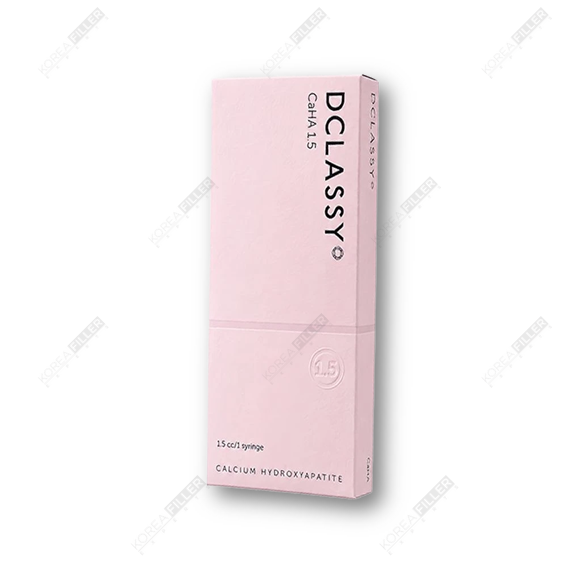
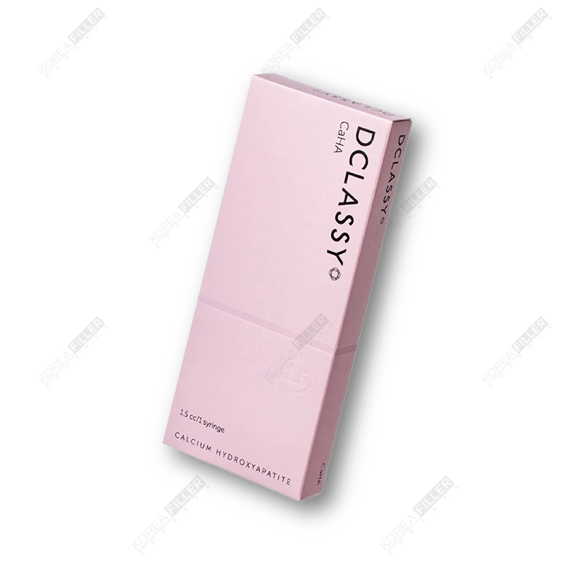

DCLASSY CaHA
DCLASSY CaHA Collagen Stimulator
Original price was: $114.90.$72.90Current price is: $72.90.
DCLASSY is an MFDS-licensed CaHA collagen stimulator from CGBio, available in 0.8 mL and 1.5 mL. It combines immediate volumizing support with gradual collagen stimulation, positioned between an HA filler and a skin booster, with results reported to last 12 to 30 months.
Professional use only. This product is intended for administration by licensed healthcare practitioners trained in the relevant anatomy and injection technique. By ordering you confirm you are authorised to purchase and handle products of this class in your jurisdiction. Availability and permitted use vary by country — please verify local regulations before ordering.
Did you like this product? Add to favorites now and follow the product.

(+82) 10 7364 7998 Send a message on WhatsApp.
DCLASSY CaHA Collagen Stimulator
DCLASSY is an injectable collagen stimulator built on calcium hydroxylapatite (CaHA) microspheres suspended in a carrier gel, manufactured by CGBio and distributed by DNCOMPANY in South Korea. It is licensed by the Korean MFDS as a tissue-repair material for the temporary improvement of facial wrinkles in adults. The carrier gel provides immediate volume at the injection site, then resorbs over several weeks, leaving the CaHA microspheres to recruit fibroblasts and stimulate new collagen, type III first and type I later, as they biodegrade over roughly 12 to 24 months. Reported results last 12 to 30 months, varying by individual. DCLASSY is positioned between a hyaluronic acid filler and a skin booster, adding structural support and gradual biostimulation without the bulk of a traditional volumizer. It is available in 0.8 mL and 1.5 mL sizes. As a CaHA-based product, it is not reversible with hyaluronidase.
30% CaHA microspheres of about 30 µm suspended in a gel carrier.
Why practitioners choose Dclassy CaHA
CaHA fillers are used where firmer support and contour are needed, such as the cheeks and jawline, and for deeper folds.
The gel carrier gives volume straight after injection, and is then gradually absorbed.
The manufacturer and the literature on CaHA fillers describe the microspheres as a scaffold on which the body’s own tissue builds, a property of this class of filler.
A prospective 24-week study of 15 patients with moderate midface volume deficiency was published in the Journal of Cosmetic Dermatology in 2025.
Treatment areas and indications
Areas where CaHA fillers such as Dclassy are used. Approved indications and age limits differ by market, so follow the instructions for use and your country’s rules.
Volume restoration in the cheeks and midface, as studied in the 2025 trial.
Moderate-to-severe folds where structural support is needed.
Definition and contour of the jawline.
Dclassy CaHA is a medical device for injection. Which indications are permitted and what training is required are set by the regulatory framework where you practise. Korea Filler Experts supplies the product. Nothing here is a recommendation to treat any medical condition, and nothing here replaces manufacturer training.
What is inside Volassom CaHA
| Product type | Calcium hydroxylapatite (CaHA) injectable collagen stimulator |
| CaHA | Microspheres suspended in a gel carrier — exact concentration not published by CGBio/DNCOMPANY |
| Gel carrier | 70%: carboxymethylcellulose, glycerin, water |
| Presentation | 0.8 mL and 1.5 mL (two separate sizes — not sold as a multi-syringe box) |
| Lidocaine | None |
| Depth (previous listing) | Mid-to-deep dermis or subcutaneous layer, depending on the goal |
| Storage (previous listing) | 2 °C to 25 °C; protect from direct sunlight |
| Manufacturer | CGBio, South Korea |
| SKU | 01207 |
Before you order
- Check the lot number and expiry on the box against the syringes.
- We do not dispatch stock with under 6 months of shelf life remaining unless agreed in advance.
- Volassom is a CaHA product, not hyaluronic acid. Confirm it is the product you intend to use.
- The product contains no lidocaine. Plan anaesthesia separately.
- Indications and approvals differ by country, so confirm what you may import and use where you practise.
Priced per box of two syringes, with a quantity discount at ten boxes.
What each component does
Calcium hydroxylapatite (CaHA) microspheres Calcium hydroxylapatite is a mineral also found naturally in bone and teeth. In DCLASSY it is formed into microspheres suspended in a carrier gel. The manufacturer does not publish the exact microsphere concentration for DCLASSY.
Carrier gel The microspheres are suspended in a carrier gel that makes the product injectable and provides volume immediately after injection. The gel’s exact composition is not published by the manufacturer or distributor.
Lattice-Pore microsphere structure The distributor describes DCLASSY’s microspheres as having a multilayer “Lattice-Pore” structure, made with a patented LPF process, intended to break down gradually from the outside in. This is the distributor’s own description — no independent data on this structure was found in the sources reviewed.
How DCLASSY Works
DCLASSY combines an immediate volumizing effect with a gradual, two-phase mechanism as the carrier gel resorbs and the CaHA microspheres remain in the tissue.
Over several weeks, the carrier gel is gradually absorbed by the body, leaving the CaHA microspheres in place.
The remaining microspheres recruit fibroblasts and stimulate new collagen — type III first, then type I — as they biodegrade over roughly 12 to 24 months.
How DCLASSY Is Used
Reference information for trained practitioners. The manufacturer’s instructions for use and your training take precedence over this page.|
Treatment area notes (clinic-reported technique, not manufacturer IFU — label accordingly if this template has a source/attribution field):
| Area | Approach |
|---|---|
| Temples, front and outer cheeks | Minimal dilution, placed to correct depressions and restore contour |
| Nasolabial folds, chin, below the mouth | Used where volume loss and reduced elasticity occur together |
| Thin skin or fine wrinkles | More diluted, spread over a wider area to improve thickness and texture |
| Mid-face and jawline | Small amounts at support points to refine contour |
| Neck | Dilution and placement adjusted to wrinkle depth, for horizontal lines and reduced elasticity |
Step by step
-
Assess and consent
Review medical history, allergies, medication, bleeding risk, previous fillers and the patient’s goals. Explain the expected result and the risks, including that CaHA cannot be dissolved with hyaluronidase.
-
Plan the treatment
Agree the area and the amount of volume. Mark the treatment area and consider the anatomy and vascular risks of the site.
-
Prepare the skin and anaesthesia
Remove make-up and cleanse. The product contains no lidocaine, so arrange topical or local anaesthesia if required.
-
Inspect the syringe
Check the packaging, seal and expiry. Use a needle or cannula recommended in the instructions for use.
-
Inject as taught
Use the depth, technique and volume stated in the instructions for use and your training, typically the mid-to-deep dermis or the subcutaneous layer. Inject slowly and with low pressure, and stop at once if the patient reports unexpected pain or you see blanching.
-
Review
Assess the result, mould gently if the technique requires it, and plan any review according to the area treated. Further sessions may be needed, depending on the size of the area.
Administration notes
Know the risks of the area. Filler can cause vascular occlusion. Practitioners should know the anatomy of the area, recognise the signs early and have an emergency protocol immediately available. Hyaluronidase does not dissolve CaHA.
Check the areas the instructions for use allow. CaHA fillers are generally not used in the lips or the eye area, so follow the instructions for use.
- Single use. One syringe, one patient. Do not reuse or resterilise. Discard any remainder with the needle.
- Do not inject into infected, inflamed or broken skin.
- Do not use in patients with known hypersensitivity to any component.
- Dispose of needles into a sharps container in line with local clinical waste rules.
After treatment
- Redness, swelling, tenderness and bruising are common and settle within days
- Avoid strenuous exercise, heat, saunas and alcohol for about 24 to 48 hours
- Seek urgent review for severe pain, blanching, skin colour change, visual change or a lump that grows or becomes tender
Storing and handling Volassom CaHA
Our previous listing gives 2 °C to 25 °C, away from direct sunlight. Follow the box and the instructions for use if they differ.
Keep the syringes in their original sterile packaging until use. Check the seal and expiry. Do not use if the packaging is damaged.
Single patient, single session. Do not reuse or resterilise. Discard the syringe and needle after use.
Do not use if the packaging is damaged or the expiry date has passed. Dispose of used syringes and needles as clinical waste in line with local requirements.
What's included with Volassom CaHA
Ask us if you need the exact box contents, including whether needles are supplied, before you order. Anaesthetic is not supplied.
Volassom CaHA — frequently asked questions
What is Volassom CaHA?
An injectable calcium hydroxylapatite (CaHA) filler from CGBio in South Korea. It is a paste of 30% CaHA microspheres in a 70% gel carrier. It is not a hyaluronic acid filler.
What is in each box?
Two 0.8 mL pre-filled syringes, in the manufacturer’s packaging.
How is a CaHA filler different from an HA filler?
HA fillers add volume with a water-binding gel that the body breaks down, and can be dissolved with hyaluronidase. A CaHA filler adds volume with a gel carrier that is absorbed over time and microspheres that remain in the tissue, and it cannot be dissolved with hyaluronidase.
Can it be dissolved?
No. Hyaluronidase does not dissolve calcium hydroxylapatite. Practitioners should be trained in CaHA technique and in the management of complications.
Does it contain lidocaine?
No. The product does not contain lidocaine, so some practitioners pair it with a separate local anaesthetic.
Is there published data on Volassom?
A prospective 24-week study of 15 patients with moderate midface volume deficiency was published in the Journal of Cosmetic Dermatology in 2025 (Hong and Park). It assessed midface volume and skin barrier function, hydration and elasticity. It was a small study, so check the original paper and the instructions for use.
How long do the results last?
We do not quote a fixed figure. Duration varies with the area, the depth and the patient. Check the manufacturer’s instructions for use.
Who can buy and use this product?
Dermal fillers are for administration by licensed healthcare practitioners trained in injection technique. We supply qualified professionals and do not sell to consumers.

Copyright 2026 © Korea Filler Experts. All right reserved.
