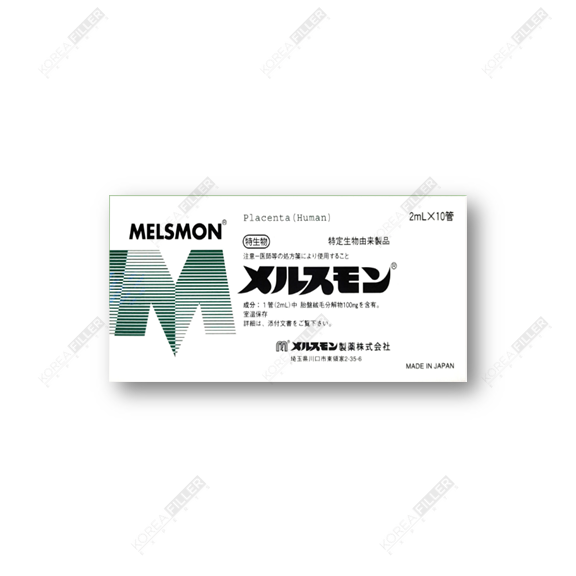
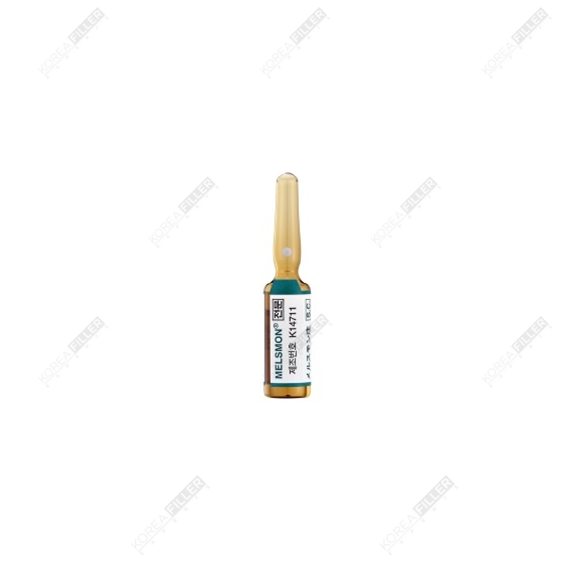
Melsmon Inj.
Human placenta hydrolysate for injection · 100 mg per 2 mL ampoule · 50 ampoules per box · Melsmon Pharmaceutical, Japan · professional use only.
$369.90
- Human placenta hydrolysate 100 mg per 2 mL
- 50 ampoules per box
- Melsmon Pharmaceutical, Japan
- Professional use only
Professional use only. This product is intended for administration by licensed healthcare practitioners trained in the relevant anatomy and injection technique. By ordering you confirm you are authorised to purchase and handle products of this class in your jurisdiction. Availability and permitted use vary by country — please verify local regulations before ordering.
Did you like this product? Add to favorites now and follow the product.

(+82) 10 7364 7998 Send a message on WhatsApp.
Melsmon Inj: human placenta hydrolysate from Melsmon Pharmaceutical, Japan
Melsmon Inj. is a human placenta hydrolysate injection made by Melsmon Pharmaceutical Co, Ltd. in Japan. Each 2 mL ampoule contains 100 mg of the water-soluble placental hydrolysate, and each box holds 50 ampoules. According to the Japanese regulator’s database, sales began in October 1956.
The Japanese label gives two uses: menopausal disorders and insufficient lactation after childbirth. Our previous page also listed skin rejuvenation, which is not part of the Japanese label. It is a prescription medicine made from human tissue, for use by licensed healthcare professionals. Dose and route follow the package insert and the prescriber.
100 mg of water-soluble placental hydrolysate in each 2 mL ampoule.
2 mL ampoules in the manufacturer's original packaging with lot number and expiry.
Menopausal disorders and insufficient lactation after childbirth.
A prescription medicine made from human tissue. Follow the package insert.
About Melsmon Inj.
Sales began in October 1956 according to the Japanese regulator’s database.
The Japanese label states that donors are interviewed and that placentas from Japan are tested for HBV, HCV and HIV-1 by nucleic acid amplification before use.
The hydrolysate is made by hydrochloric acid hydrolysis, with heating at 101 °C or above for at least one hour and steam sterilisation at 121 °C for 60 minutes.
The ampoule has a marked break point, so no file is needed to open it.
Use and information
The first two items are the uses on the Japanese label. The last item is a use our previous page listed. Approved indications differ by market, so follow the package insert for your country.
Labelled use in Japan. Our previous page described the symptoms as hot flashes, sensitivity to cold, insomnia, irritability, headache, fatigue and stiff neck or shoulders.
Labelled use in Japan, for poor milk production after childbirth.
Our previous page listed dullness and reduced elasticity. This is not part of the Japanese label, and whether it is appropriate is for the prescriber to decide.
Melsmon Inj. is a prescription medicine made from human tissue. Which uses are permitted and who may supply or administer it are set by the regulatory framework where you practise. Korea Filler Experts supplies the product to licensed professionals. Nothing here is medical advice or a recommendation to treat any condition.
What is inside Melsmon Inj.
| Product type | Human placenta hydrolysate solution for injection |
| Active ingredient | Water-soluble placental hydrolysate, 100 mg per 2 mL ampoule |
| Packing | 2 mL × 50 ampoules per box |
| Added ingredient | Benzyl alcohol (0.03 mL per ampoule on the Japanese label) |
| Appearance | Slightly yellow, clear solution; pH 6.8–7.0 |
| Route (Japanese label) | Subcutaneous injection only |
| Labelled uses (Japan) | Menopausal disorders; insufficient lactation |
| Manufacturer | Melsmon Pharmaceutical Co, Ltd, Japan |
Before you order
- This is a prescription medicine made from human tissue. Order only if you are licensed to prescribe, administer or supply it where you practise, and check the import rules for your country, because rules for human-derived products can be stricter.
- In Japan it is a specially designated biological product, and the user must record the product name, lot number, date and patient details and keep the record for at least 20 years.
- Check the storage and shelf life on your carton. The Japanese label gives room-temperature storage and a 3-year shelf life.
- We do not dispatch stock with under 6 months of shelf life remaining unless agreed in advance.
Quantity discounts apply at five, ten and twenty boxes.
What each component does
Placental hydrolysate, 100 mg per 2 mL
The active ingredient is a water-soluble mixture of substances from hydrolysed human placenta. The Japanese label says no single compound can be named as the active ingredient. It lists the amino acids that have been measured, including lysine, alanine, aspartic acid, leucine, glutamic acid, glycine, valine, serine, tyrosine, phenylalanine, threonine, arginine, proline, isoleucine, methionine and histidine.
How it is made safe
The label describes donor interviews, serological tests, nucleic acid testing for HBV, HCV and HIV-1, hydrochloric acid heating at 101 °C or above for one hour or more, and steam sterilisation at 121 °C for 60 minutes. It also states that the risk of infection from a product made from human placenta cannot be excluded completely, including a theoretical risk of variant Creutzfeldt-Jakob disease, and that no case of transmission has been reported.
Packing
2 mL × 50 ampoules per box. The carton shows the lot number and expiry date.
Handling and preparation
General handling points for trained professionals. The package insert and your prescriber’s instructions take precedence over this page, and we do not give dosing advice.
Step by step
-
Check the product
Confirm the name, lot number and expiry on the carton and ampoule. The solution should be slightly yellow and clear; do not use it if it is cloudy or contains particles.
-
Explain the product to the patient
The Japanese label asks the prescriber to explain that the product is made from human placenta and that the risk of infection cannot be excluded completely, and to obtain the patient’s understanding.
-
Open carefully
The ampoule has a one-point-cut mark. Wipe the cut area with an ethanol swab and snap it off away from the mark, without using a file.
-
Administer as directed
Give by the route the package insert states. The Japanese label allows subcutaneous injection only. A qualified professional should administer it.
-
Record and discard
Record the product, lot number, date and patient details as required. Discard any unused solution and the ampoule as clinical waste.
Administration notes
Use only as directed. Dose, interval and route come from the package insert and the prescriber, not from this page.
- The Japanese label contraindicates use in patients with a history of hypersensitivity to this or other medicines.
- Our previous page also advised against use in pregnancy and in active malignancy, and caution in autoimmune conditions treated with immunosuppressants. These are not on the Japanese label and are kept here as extra precautions.
- Observe the patient. Shock can occur, frequency unknown.
- Contains benzyl alcohol.
- Single use only. Do not reuse.
Storing and handling Melsmon Inj.
The Japanese label gives room-temperature storage and a shelf life of 3 years. Follow the carton and package insert for your batch if they differ.
Keep ampoules in their original carton until use. Check the seal, appearance and expiry.
Each ampoule is a single dose. Use immediately and discard any remainder.
Do not use if the packaging is damaged or the expiry date has passed. Dispose of used ampoules, syringes and needles as clinical waste in line with local requirements.
What's included with Melsmon Inj.
Syringes and needles are not included. Check the package insert for what you need to administer the product.
Melsmon Inj. — frequently asked questions
What is Melsmon Inj?
A human placenta hydrolysate injection from Melsmon Pharmaceutical in Japan. Each 2 mL ampoule contains 100 mg of the water-soluble placental hydrolysate, and each box holds 50 ampoules.
What is it labelled for?
The Japanese label gives two uses: menopausal disorders and insufficient lactation after childbirth. Approved uses differ by country, so check the package insert for your market.
Is skin rejuvenation a labelled use?
No. Skin rejuvenation was listed on our previous page, but it is not part of the Japanese label, and any use beyond the label is the prescriber’s responsibility.
What clinical data does the Japanese label report?
Japanese post-marketing studies, both placebo-controlled: a response rate of 77.4% (24 of 31) in menopausal patients given six injections over two weeks, and 68.6% (46 of 67) in first-time mothers given daily injections for five days after delivery. These are small studies from 1981.
Is it safe to use a product made from human placenta?
The manufacturer screens donors and tests the placentas, and the process includes acid and heat treatment. The Japanese label still states that the risk of infection cannot be excluded completely, and it asks prescribers to explain this to patients.
Which side effects are listed?
Shock (frequency unknown); chills, nausea, fever, redness and rash; and pain or redness at the injection site.
How is it stored?
The Japanese label says room temperature with a shelf life of 3 years. Check your carton.
Who can buy this product?
It is a prescription medicine, supplied to licensed healthcare professionals and not to consumers. You are responsible for checking that you may import and use it where you practise.
Recently Viewed Products

Copyright 2026 © Korea Filler Experts. All right reserved.
