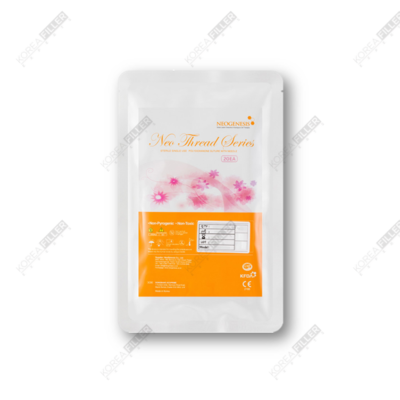

NEO Double Needle Combi (360-Multi: Premium Needle)
Polydioxanone (PDO) cog thread · 360° multi-directional barbs · needle at both ends · 19G × 110 mm. Sold singly.
Price range: $52.90 through $61.90
You save
Neo Double Needle Thread PDO is a polydioxanone threads on two needles used for the thread lifting of face and neck. Polydioxanone (PDO) is a flexible polymer, which remains intact in the injection point up to 6 months. Threads created based on PDO exhibit multiple effects: their subcutaneous injection initiates skin self-regeneration by increasing collagen synthesis and improving blood microcirculation. As a result of the application of polydioxanone threads the significant lifting effect is observed accompanied by wrinkles elimination, small skin imperfections diminishment, as well as elasticity improvement.
Types example :
| Model Code | Needle Size | Needle Length | Threads Length | USP |
| M3112 | 31G | 12mm | 16mm | 7-0 |
Professional use only. This product is intended for administration by licensed healthcare practitioners trained in the relevant anatomy and injection technique. By ordering you confirm you are authorised to purchase and handle products of this class in your jurisdiction. Availability and permitted use vary by country — please verify local regulations before ordering.
Did you like this product? Add to favorites now and follow the product.

(+82) 10 7364 7998 Send a message on WhatsApp.
A barbed thread with a needle at each end
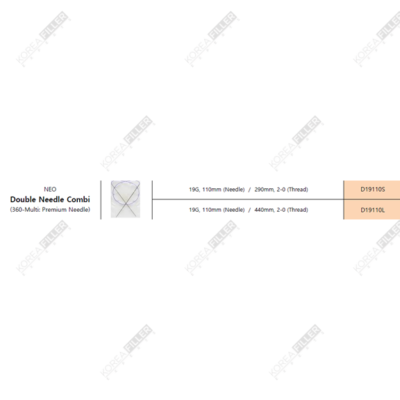
NEO Double Needle Combi is a barbed polydioxanone thread with a 19G × 110 mm needle mounted at each end. Both halves carry 360° multi-directional cogs, and the thread spans 290 mm or 440 mm between the needles depending on which version you order.
The double-needle format exists for vectors that need to be anchored from two directions, or that run further than a single-needle thread can span. You enter at a mid-point, pass one needle out along the first vector, then the second along the opposite one — placing a single continuous barbed thread across a span no single-ended thread could cover.
This is a specialist product. It is the heaviest gauge in the range, the longest span, and the only item sold singly rather than in a pack. It is for practitioners with established cog thread experience who need a specific long-vector solution — not a first barbed thread.
Place one continuous barbed thread across two opposing vectors from a single mid-point entry.
Two versions. The long one covers spans no single-ended thread in this range can reach.
Cogs cut around the full circumference, so grip does not depend on the thread's rotation.
The only product here supplied as one piece rather than a pack — and the two lengths are priced differently.
Why practitioners stock NEO Double Needle Combi
At 440 mm between needles, this covers vectors that would otherwise need two separate threads and two separate anchor decisions.
Entering mid-point and working outward in both directions places a single thread across opposing vectors, with no join in the middle to fail.
360° barbing means the thread engages whichever way it rotates during insertion — one fewer variable across a long pass.
Sold singly rather than in packs of twenty, which suits a product used selectively in specific cases.
Treatment areas
Applications where a continuous barbed thread across two opposing vectors is the right solution. This is a specialist product — most cog thread work does not need it.
Spans running from one side of the lower face across to the other, or extended mandibular vectors where a single-ended thread would fall short. The principal use for the 440 mm version.
Where two vectors pull in opposite directions from a shared mid-point, supported by one continuous thread rather than two separately anchored ones.
Early submental laxity across a span wider than one needle can cover. Marked platysmal banding or significant submental fat remains a surgical conversation.
Adding a continuous span where earlier thread work has left a gap between supported zones. Requires knowing what is already in situ — previous threads alter the planes.
PDO threads are sterile implantable medical devices. Which applications are permitted, and what training is required, is determined by the regulatory framework where you practise. Barbed threads produce a mechanical result that depends almost entirely on operator technique. Korea Filler Experts supplies the product; nothing here is a recommendation to treat any condition, and nothing here substitutes for hands-on training.
Available sizes and specifications
| D19110S | 19G · 110 mm needles · 290 mm thread span · USP 2-0 |
| D19110L | 19G · 110 mm needles · 440 mm thread span · USP 2-0 |
| Material | Polydioxanone (PDO) |
| Configuration | Sharp needle mounted at both ends |
| Barb configuration | 360° multi-directional cogs |
| Pack size | 1 piece |
| Sterilisation | Sterile, single use only |
| Storage | Room temperature, dry, away from sunlight |
Checking the pack
- The code suffix matches your order — S is 290 mm, L is 440 mm. They are otherwise identical.
- The blister is intact and dry. A breached sterile barrier makes it waste.
- The expiry date is clear. PDO hydrolyses with moisture.
- This is supplied as one piece — check quantity against your order.
Two sharp needles, both live. Sharps handling needs more care than usual with this product: the second needle is exposed while you are working with the first.
What each component does
S and L — the only difference that matters
Both versions share the same 19G × 110 mm needles, the same USP 2-0 filament and the same 360° barbing. They differ only in the span between the needles:
- D19110S — 290 mm span
- D19110L — 440 mm span, and priced higher accordingly
Choose by measuring the vector pair you intend to cover, not by assuming longer is better. Excess thread has to go somewhere, and on a barbed product that somewhere is tissue you did not plan to engage.
What the double-needle format is for
A conventional cog thread is placed from one end: you enter, advance, withdraw, and the thread anchors along the track it travelled. Span is limited by needle length and by how far you can reach from one entry.
With a needle at each end you enter at a mid-point and work outward twice. The thread is continuous across both vectors, so there is no join and no second anchor decision — the two halves support each other through the shared midsection.
Where that helps is a long, continuous span needing support from both directions. Where it does not help is anywhere a single shorter thread would do, which is most cases.
Reading the specifications
- 19G — needle diameter; higher number means thinner. This is the heaviest sharp needle in the NEO range.
- 110 mm needles — each needle, not the thread. The thread span is the separate figure above.
- USP 2-0 — filament thickness on the standard suture scale, where more zeros means thinner. 2-0 is the heaviest here, which a long barbed span requires.
How to use NEO Double Needle Combi
Reference information for practitioners with established barbed thread experience. This is the heaviest gauge, the longest span and the most technically demanding product in the NEO range. It is not an appropriate first cog thread.
Step by step
-
Measure the vector pair before choosing S or L
Mark both vectors with the patient upright and measure the total span. Order length to match — excess barbed thread engages tissue you did not plan to engage.
-
Plan the mid-point entry
The entry sits between the two vectors rather than at one end. Site it where both passes can be made cleanly and where a small mark is inconspicuous.
-
Prepare and anaesthetise
Thorough antisepsis — this is an implant. Local anaesthetic at the entry and along both tracks; this is a substantial procedure at 19G.
-
Place the first vector
Enter and advance the first needle along the planned track in the subcutaneous plane, bringing it out at the far point. Maintain consistent depth across the full length.
-
Secure the midsection before the second pass
Keep the mid-portion of the thread controlled while you reposition. A loose barbed midsection can engage tissue prematurely and in the wrong place.
-
Place the second vector
Advance the second needle along the opposing track from the same entry, matching the depth of the first pass.
-
Redrape, assess sitting up, then trim
Redrape along both vectors to seat the barbs, sit the patient up to check symmetry, then trim both ends flush with tissue in neutral position.
Administration notes
Control the midsection. This is the technique point unique to the double-needle format. Between the first and second pass, a length of barbed thread sits partly in tissue and partly free. Left unmanaged it catches where you did not intend, and a barbed thread that has engaged in the wrong plane is difficult to retrieve.
Match depth across both passes. The two vectors share one continuous thread, so a depth mismatch between them puts the midsection under uneven tension and shows as asymmetry.
Sharps discipline. Two live needles on one device, and the second is exposed throughout the first pass. Account for both at every stage.
- Single use. Never re-sterilise or reuse.
- Do not place across active infection, recent filler, or previous permanent implant.
- Do not use this product in the forehead or periorbital region. A 19G × 110 mm sharp needle near the supraorbital and supratrochlear vessels is not an acceptable risk, whatever earlier listings suggested.
- Dispose of both needles into a sharps container per local clinical waste requirements.
After treatment
- Swelling, bruising and a tight or pulling sensation are expected for one to two weeks, and are typically more pronounced than with lighter cog threads
- Minimal facial movement for two weeks — no wide yawning, big smiles or tough food
- Sleep on the back, head elevated, for the first week
- No facial massage, facials or dental work for three to four weeks
- No saunas, steam rooms or strenuous exercise for two weeks
- Review at two weeks. Spreading redness, increasing pain, discharge or visible thread extrusion needs seeing promptly
Storing and handling NEO Double Needle Combi
Store at room temperature in a dry place, away from direct sunlight. No refrigeration, no cold chain.
Individually sealed and sterile. Do not use if the blister is open, torn, damp or damaged. Never re-sterilise — autoclaving destroys PDO.
Handle with more care than a single-needle product. Both needles are live from the moment the pack is opened, and the second remains exposed throughout the first pass.
Single use only. Do not reuse, re-sterilise or repackage. Dispose of both needles into a sharps container and unused product as clinical waste in line with local requirements.
What's included
This product is supplied as a single piece, not a pack — order quantities accordingly. The 440 mm version is priced higher than the 290 mm. Antiseptic, local anaesthetic, marking pen and sharps disposal are not supplied.
NEO Double Needle Combi — frequently asked questions
What is a double-needle thread?
A barbed polydioxanone thread with a sharp 19G × 110 mm needle mounted at each end. You enter at a mid-point and advance one needle out along the first vector, then the second along the opposing one — placing a single continuous barbed thread across both.
When would I use this instead of a standard cog thread?
When the span is longer than a single-ended thread can cover, or when a vector pair needs supporting from both directions with one continuous thread rather than two separate ones.
For most jawline and midface work a conventional cog thread is the simpler and better choice. This is a specific solution to a specific problem.
What is the difference between the S and L versions?
Only the span between the needles: 290 mm for the S, 440 mm for the L, which is priced higher. Needles, gauge, filament and barbing are identical.
Measure the vector pair and order to match. Excess barbed thread engages tissue you did not plan to engage, so longer is not automatically better.
Can I use it on the body — arms, chest, buttocks?
We have removed those applications from this listing. Threads do not reshape body contour; they stimulate collagen and, when barbed, reposition soft tissue to a limited degree.
Body thread procedures involve large volumes of tissue, long vectors and — in some regions — a risk profile that does not justify the result. Buttock thread procedures in particular are an area where claims have run well ahead of evidence. We would rather not sell this product on that basis.
What about the forehead or brow?
No. A 19G × 110 mm sharp needle passing near the supraorbital and supratrochlear vessels is not an acceptable risk, and the earlier listing should not have suggested it.
Brow work with threads, where appropriate at all, uses finer threads, shorter needles and a quite different approach.
Is this suitable as a first barbed thread?
No. It is the heaviest gauge, the longest span and the most technically demanding product in the range — and the midsection management between passes is a skill specific to this format.
Start with our Cog Cannula, which is blunt-tipped and far more forgiving.
Why is it sold singly?
Because it is used selectively rather than in quantity. Buying one at a time suits a product you might use on a handful of cases rather than routinely.
How long does the result last?
The PDO hydrolyses over roughly six months, so the mechanical support is temporary. The collagen laid down around the thread persists beyond that.
Duration varies widely with tissue, vector plan and technique. Assess at review rather than promising a figure.
Do they need refrigeration?
No. Room temperature, dry, out of direct sunlight — no cold chain to manage.
Who can buy and use these?
Barbed threads are sterile implantable medical devices with a higher risk profile than smooth threads, and this is the most demanding of them. It requires established cog thread experience, confident long-vector planning and good sharps discipline with two live needles. We supply to practitioners qualified to perform the procedure in their jurisdiction, and do not sell to consumers.

Copyright 2026 © Korea Filler Experts. All right reserved.
