


Nabota 100UI
Clostridium botulinum toxin type A · 100 units · lyophilised powder, single-dose vial. Manufactured by Daewoong Pharmaceutical, South Korea.
$68.90
You save
Nabota 100UI is a high-purity botulinum toxin type A from Daewoong Pharmaceutical — the first Asian toxin approved by the FDA, EMA, and Health Canada. Marketed as Jeuveau in the US, it’s built on patented Hi-Pure Technology for minimal impurities.
Professional use only. This product is intended for administration by licensed healthcare practitioners trained in the relevant anatomy and injection technique. By ordering you confirm you are authorised to purchase and handle products of this class in your jurisdiction. Availability and permitted use vary by country — please verify local regulations before ordering.
In accordance with applicable U.S. FDA regulations, this product is not available for purchase or shipment to U.S. addresses through this website. Customers in the United States should obtain botulinum toxin products through appropriately licensed and authorized U.S. distribution channels. A valid medical license or registration certificate is required to process any product-related claim.
Did you like this product? Add to favorites now and follow the product.

(+82) 10 7364 7998 Send a message on WhatsApp.
Daewoong's botulinum toxin type A, with a published Phase III evidence base
Nabota is the botulinum toxin type A product developed and manufactured by Daewoong Pharmaceutical, one of South Korea’s largest pharmaceutical companies. It launched in the Korean market in 2014 and is supplied as a sterile lyophilised powder in a single 100-unit vial, reconstituted with preservative-free 0.9% sodium chloride before use.
The active substance — prabotulinumtoxinA — was the first Asian-manufactured botulinum toxin to gain United States FDA approval, marketed there as Jeuveau by a licensed partner, and in Europe and Canada as Nuceiva. That gives this formulation a published clinical record that most Korean toxins do not have.
Two identical randomised, double-blind, placebo-controlled Phase III studies in adults with moderate to severe glabellar lines reported day-30 responder rates of 67.5% and 70.4%, against 1.2% and 1.3% for placebo. No serious adverse event in either study was assessed as related to the study drug.
Worth stating plainly: those approvals belong to Jeuveau and Nuceiva, which are separate registrations. A Korean-market Nabota carton is not the FDA-approved US article, and we do not represent it as one. Confirm what is registered and lawfully supplied where you practise.
Day-30 responder rates of 67.5% and 70.4% versus placebo across two identical randomised controlled trials.
Effect was measured at day 30 in the Phase III programme. Clinics commonly review patients at three to four months.
Botulinum toxin type A with human serum albumin as stabiliser and sodium chloride for tonicity — a short, well-characterised excipient list.
Reconstitution volume is chosen by the injector, so one 100 U vial can be prepared at several concentrations.
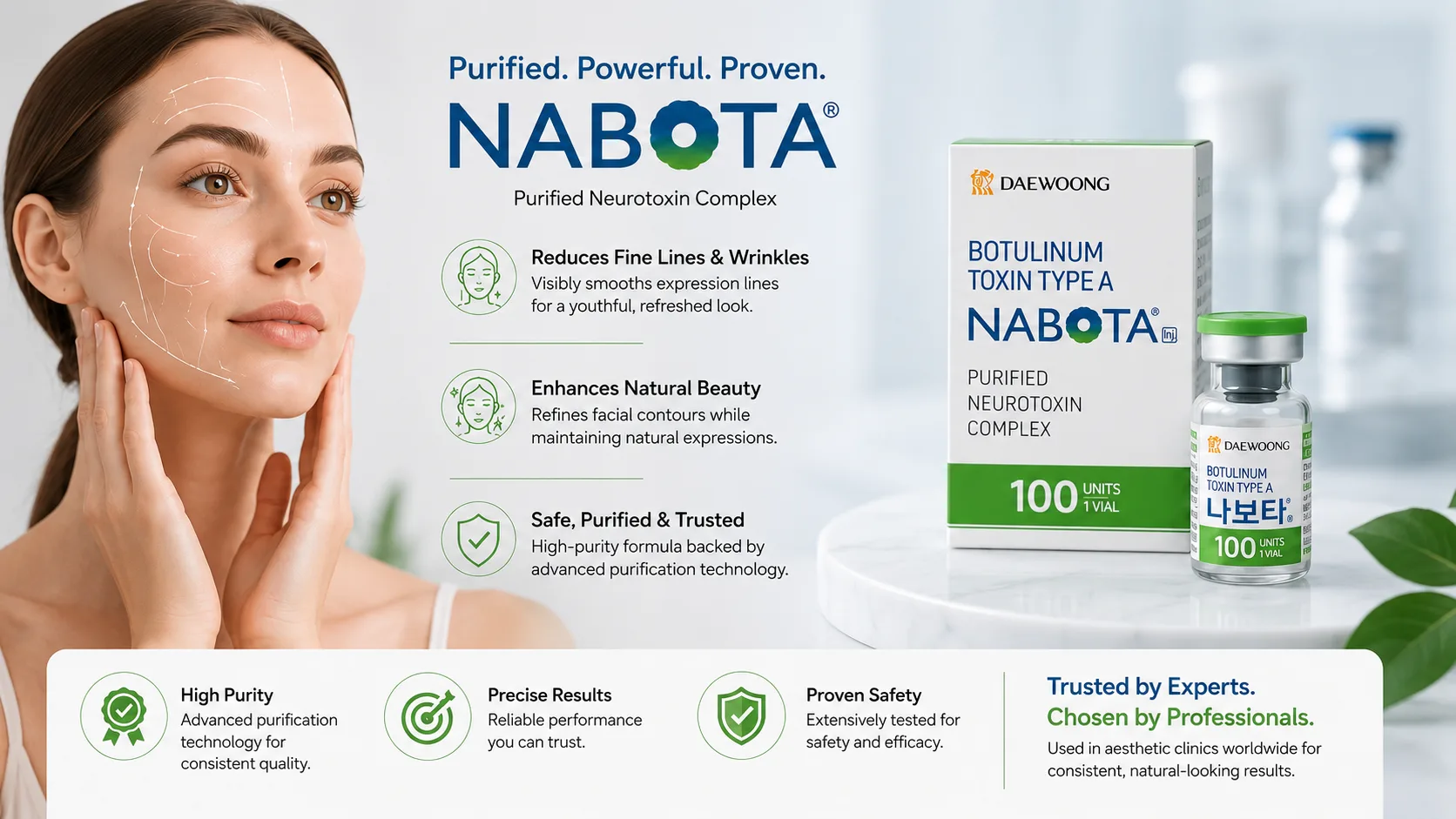
Why practitioners choose Nabota 100UI
Two identical randomised, placebo-controlled trials in glabellar lines reported day-30 responder rates of 67.5% and 70.4%, against 1.2% and 1.3% for placebo.
The same active substance holds FDA approval as Jeuveau and European and Canadian approval as Nuceiva — a depth of regulatory review that is unusual for this category.
Produced at Daewoong’s biologics plant in South Korea, with each batch released against defined specifications for potency, sterility, endotoxin and appearance.
100 U, 150 U and 200 U share the same formulation, so vial size can be matched to session volume without changing product.
Aesthetic & therapeutic applications
The approved indication for the active substance in this product, as reflected in the regulatory labelling of prabotulinumtoxinA, is set out first below. The remaining areas are commonly treated in practice, but approval status differs between markets — always work from the prescribing information registered in the country where you practise.
Temporary improvement in the appearance of moderate to severe glabellar lines associated with corrugator and/or procerus muscle activity in adults. This is the indication under which the active substance holds international approval, and the endpoint used in its Phase III programme.
Lines at the outer eye produced by orbicularis oculi activity. Widely treated in aesthetic practice, though whether it is an approved indication for this product depends on your market — it is not covered by the US approval of the partner brand.
Horizontal forehead lines from frontalis activity. Commonly treated alongside the glabella rather than in isolation, since relaxing the glabellar complex on its own can alter brow position. A clinical decision for the treating practitioner within local regulations.
Involuntary eyelid muscle spasm in adult patients. Registered as a therapeutic indication in some markets and not others — check the prescribing information approved where you practise before treating.
Botulinum toxin products are prescription-only medicines. Any use outside the indications approved in your jurisdiction is a clinical decision made by the treating practitioner under their own professional judgement and local regulatory framework. Korea Filler Experts supplies the product; nothing here should be read as a recommendation to treat any medical condition.
What is inside Nabota 100UI
| Active substance | Clostridium botulinum toxin type A (haemagglutinin complex) |
| Strength | 100 Units per vial |
| Stabiliser | Human serum albumin, 0.5 mg |
| Tonicity agent | Sodium chloride, 0.9 mg |
| Pharmaceutical form | Lyophilised powder for solution for injection |
| Appearance | White to off-white cake or powder |
| Diluent | Preservative-free 0.9% sodium chloride injection (not supplied) |
| Container | Type I glass vial, rubber stopper, aluminium flip-off cap |
| Route | Intramuscular injection |
| Shelf life | Up to 36 months from manufacture |
| Manufacturer | Daewoong Pharmaceutical Co, Ltd, Republic of Korea |
| Regulatory class | Prescription-only medicine (professional use) |
Reading the carton
Genuine Korean-market cartons are printed primarily in Korean with the product name in Latin script. Before you accept a delivery, check four things:
- The lot / batch number on the carton matches the number printed on the vial label.
- The expiry date leaves you enough working life — we do not dispatch stock with under 6 months remaining unless agreed in advance.
- The flip-off cap is intact and the vial seal has not been disturbed.
- The carton arrived cold, with the coolant pack still chilled.
Vial looks empty? The contents are freeze-dried under vacuum, so the powder often forms a thin film that is hard to see against the glass. An apparently empty vial is expected and is not a sign of a short-filled or counterfeit product.
What each component does
- Botulinum toxin type A — the active substance. It temporarily reduces the release of acetylcholine at the neuromuscular junction, lowering activity in the injected muscle.
- Human serum albumin — stabilises the toxin protein through freeze-drying, storage and reconstitution.
- Sodium chloride — brings the reconstituted solution to a tonicity suitable for injection.
How Nabota Is Made?
Daewoong produces the toxin through controlled fermentation of Clostridium botulinum. Then, the company extracts and purifies it using their patented Hi-Pure Technology. This step reduces impurities and non-essential proteins that lower-purity formulations often retain.
This purity matters clinically. Accessory proteins in less-purified toxins can trigger immune recognition over repeated use. Consequently, this may lead to neutralizing antibody formation and reduced effectiveness over time. Because Nabota’s purification process specifically targets this risk, practitioners often consider it suitable for patients who have used other botulinum toxins without developing resistance.
After intramuscular injection, botulinum toxin type A binds with high affinity to receptors on presynaptic cholinergic nerve terminals. The light chain is internalised and cleaves SNAP-25, a protein required for the vesicle fusion that releases acetylcholine into the synaptic cleft.
Neurotransmitter release falls, temporarily lowering activity in the injected muscle. The effect is not permanent: nerve terminal function recovers over time, which is why treatment is repeated.
How to prepare and use Nabota 100UI
Reference information for licensed practitioners. Reconstitution and administration must follow the prescribing information approved in your market and your own clinical governance procedures.
Step by step
-
Bring the vial to working condition
Take the vial from refrigerated storage and inspect the label, lot number and expiry date. Confirm the flip-off cap is intact.
-
Prepare the diluent
Draw the required volume of preservative-free 0.9% sodium chloride injection into a sterile syringe.
-
Disinfect the stopper
Remove the flip-off cap and wipe the exposed rubber stopper with an alcohol swab. Allow it to dry.
-
Introduce the diluent slowly
Insert the needle at an angle and let the vacuum draw the saline in. Direct the stream against the vial wall rather than onto the powder.
-
Mix gently
Rotate the vial slowly to dissolve the cake. Do not shake vigorously — agitation can denature the protein. The solution should be clear, colourless and free of particulates.
-
Record and use promptly
Note the reconstitution date and time on the vial. Keep it refrigerated at 2–8 °C and use within the period stated in your approved prescribing information.
Dilution reference
| Diluent added | Units per 0.1 mL | Total volume |
|---|---|---|
| 1.0 mL | 10.0 U | 1.0 mL |
| 1.25 mL | 8.0 U | 1.25 mL |
| 2.0 mL | 5.0 U | 2.0 mL |
| 2.5 mL | 4.0 U | 2.5 mL |
| 4.0 mL | 2.5 U | 4.0 mL |
| 5.0 mL | 2.0 U | 5.0 mL |
Administration notes
Because the powder is freeze-dried under vacuum, the vial can look nearly empty before reconstitution. This is normal and the full dose is present.
Materials needed: preservative-free 0.9% sterile saline, a sterile syringe with a fine-gauge needle, gloves and alcohol swabs. None of these are supplied with the vial.
- Units of botulinum toxin are product-specific. Do not convert or substitute units between brands — a Nabota unit is not interchangeable with a unit of any other toxin.
- Dose per site, total dose and injection technique must follow the prescribing information approved in your market.
- Draw reconstituted product immediately before injection.
- Treatment intervals should not be shortened below the minimum stated in the prescribing information.
After treatment
- Avoid rubbing or massaging the treated area for at least 24 hours
- Stay upright and avoid lying down for 4 to 6 hours
- Avoid strenuous exercise for 24 to 48 hours
- Avoid saunas, hot tubs and excessive sun exposure for at least 24 hours
- Delay facials, microdermabrasion or chemical peels for at least a week
- Mild redness, swelling or bruising can occur and usually settles within a few days
Storing and handling Nabota 100UI
Store refrigerated at 2–8 °C in the original carton, protected from light. Do not freeze. Shelf life is up to 36 months from manufacture — always work to the printed expiry date.
Keep at 2–8 °C and use within the period specified in your approved prescribing information. Do not freeze reconstituted solution. Single-patient use only.
Transfer stock into a monitored medical refrigerator on arrival and keep a temperature log. If a shipment arrives warm, photograph the packaging and contact us before putting it into clinical service.
Do not use the vial if the powder is discoloured, if the reconstituted solution is cloudy or contains particles, if the expiry date has passed, or if the cold chain is known to have been broken. Dispose of unused product and used vials as clinical waste in line with local requirements.
What's included with Nabota 100UI
Diluent (0.9% sodium chloride injection), syringes and needles are not supplied with this product and must be sourced separately.
Nabota 100UI — frequently asked questions
What is Nabota 100UI?
Nabota 100UI is a botulinum toxin type A product manufactured by Daewoong Pharmaceutical in South Korea. It is supplied as a sterile freeze-dried powder in a single 100-unit vial and reconstituted with preservative-free 0.9% sodium chloride before injection by a licensed practitioner.
Is Nabota the same as Jeuveau?
The active substance is the same — prabotulinumtoxinA — and it received United States FDA approval in February 2019, marketed there as Jeuveau by a licensed commercial partner. In Europe and Canada the same substance is approved as Nuceiva.
Those are separate registrations. A Korean-market Nabota carton is not the FDA-approved, US-labelled article, and we do not represent it as such. Practitioners should confirm what is approved and lawfully supplied in their own country before ordering.
What clinical evidence supports this formulation?
Two identical 150-day, randomised, double-blind, placebo-controlled Phase III studies enrolled adults with moderate to severe glabellar lines (n = 330 and n = 324), randomised 3:1 to 20 units or placebo. Day-30 responder rates were 67.5% and 70.4% in the active groups versus 1.2% and 1.3% for placebo. No serious adverse event in either study was assessed as related to the study drug.
A separate Phase II study of a 40-unit dose reported a duration of effect of approximately six months. These describe study populations, not a promise of individual outcome.
Why does the vial look empty?
The contents are freeze-dried under vacuum, so 100 units of active substance form a very thin, almost transparent film on the base or wall of the vial. This is normal for lyophilised toxins and is not a sign of a short fill or a counterfeit. The powder becomes obvious once saline is introduced.
How should I dilute a 100 U vial?
Dilution volume is chosen by the practitioner. Adding 2.5 mL of preservative-free 0.9% sodium chloride gives 4 units per 0.1 mL, which is a commonly used concentration; the reference table above lists other volumes. Always follow the reconstitution instructions in the prescribing information approved for your market.
Should I order the 100 U, 150 U or 200 U vial?
All three share the same formulation, so the choice is about session volume rather than product. The 100 U vial suits face-focused treatment lists; the larger vials reduce the number opened when treating larger muscle groups or running high-volume sessions. Reconstituted product is single-patient use, so size the vial to the session rather than the week.
Can I store the vial at room temperature?
No. Store unopened vials refrigerated at 2–8 °C in the original carton, protected from light, and do not freeze. Reconstituted solution should also be kept at 2–8 °C and used within the period stated in your approved prescribing information.
Can I substitute Nabota units for another brand's units?
No. Units of botulinum toxin are specific to each product and are not interchangeable between brands. Dosing must be taken from the prescribing information for the product in your hand.
What shelf life will my stock have?
We do not dispatch stock with less than six months of remaining shelf life unless you have specifically agreed to it. If you need a particular expiry window, tell us before you order and we will allocate accordingly.
What happens if my shipment arrives warm?
Do not use it. Photograph the outer box, the insulated liner, the coolant packs and the vial carton, and contact us the same day with your order number. We will review the cold-chain evidence and arrange a replacement where the failure occurred in transit.
Who is allowed to buy this product?
Botulinum toxin is a prescription-only medicine. Purchase and use are restricted to licensed healthcare professionals qualified to prescribe or administer injectable prescription medicines in their jurisdiction, with appropriate training in the relevant anatomy and injection technique. We do not sell to consumers.
Customer Reviews
Share your experience with this product. Your honest review helps other customers make better choices.
- Sort By
- Newest
- Oldest
- Highest Rating
- Lowest Rating
Straight into the reorder cart. One of my staples at this point.
Always a reliable choice. No complaints at all.
Great toxin. Natural result and very satisfied.
I wanted a predictable result and this delivered what I expected. The outcome looked natural and still allowed normal facial movement.
The effect was exactly within the range I wanted. I still had natural movement, but the treated areas looked smoother.
The sweet spot for me is looking smoother while still being able to move my face normally. That's where I ended up with this treatment, so I'm very pleased.
What I wanted was simple: soften things without completely losing expression. That's pretty much where I ended up, so no complaints from me.
I chose this because I wanted something reliable. The experience matched my expectations and the result looked clean without feeling overdone.
Excellent product , helpful staff if I've had any queries and arrived very quickly , kept in contact from being dispatched and with which courier, I will be continuing to order from this company.

Copyright 2026 © Korea Filler Experts. All right reserved.
