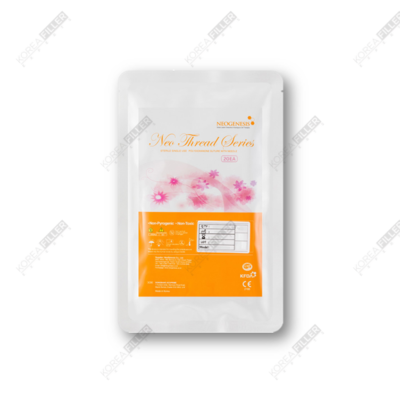

NEO Combi Cog Thread (360-Multi: Premium Needle)
Polydioxanone (PDO) cog thread · 360° multi-directional barbs · 21G and 23G premium needle. 20 pieces per pack.
$124.90
You save
- Neo Combi Thread (Multi-Directional) PDO are polydioxanone threads with multidirectional barbs designed for skin lifting at the muscular level.
Combi threads is a model of thin threads with deep multi-directional barbs for a skin lifting on a muscular level.Types example :Model Code Needle Size Needle Length Threads Length USP M3112 31G 12mm 16mm 7-0
Professional use only. This product is intended for administration by licensed healthcare practitioners trained in the relevant anatomy and injection technique. By ordering you confirm you are authorised to purchase and handle products of this class in your jurisdiction. Availability and permitted use vary by country — please verify local regulations before ordering.
Did you like this product? Add to favorites now and follow the product.

(+82) 10 7364 7998 Send a message on WhatsApp.
Multi-directional barbs on a thin, deep-placement thread
NEO Combi Cog Thread is a barbed polydioxanone thread with 360° multi-directional cogs — barbs cut around the full circumference of the filament rather than in one or two planes.
The practical consequence is grip from any angle. A thread with barbs on two faces only engages tissue well when it is oriented correctly; a 360-barbed thread engages regardless of how it rotates during insertion. That makes placement more forgiving and the hold more consistent along the track.
The other distinguishing feature is that it is a thin thread placed deep. At USP 2-0 to 3-0 on a 21G or 23G sharp needle, it is finer than most cog threads while still being delivered at the muscular plane, where the tissue it engages is substantial enough to hold.
360° cogs engage tissue whatever the thread's rotation, so grip does not depend on getting orientation right.
USP 2-0 to 3-0 delivered at the muscular plane — finer than most cog threads for the holding power.
21G at 60 mm and 90 mm; 23G at 38, 50, 60 and 90 mm. Vector length matched to the zone.
Mechanical support while the thread is intact, plus the collagen response that outlasts it.
Why practitioners stock NEO Combi Cog
With barbs around the full circumference, the thread holds whichever way it rotates on insertion — one less variable in a technique that has plenty of them.
USP 2-0 to 3-0 on a 21G or 23G needle. Less bulk in tissue for the same barbed function.
No separate entry port needed, unlike the blunt cannula format. Faster placement where bruising risk is acceptable.
From 38 mm for short midface vectors up to 90 mm needles carrying 150 mm threads for full jawline spans.
Treatment areas
Areas where multi-directional cog threads are used to reposition tissue. All are facial applications — this is a thin thread for facial planes, not a body product.
Vectors along the mandibular border to gather and support descended tissue, restoring a defined jaw angle. The 60 mm and 90 mm options exist for this span.
Lifting malar and submalar tissue along an oblique vector. The 38 mm and 50 mm needles suit these shorter runs, where a longer thread would overshoot the target.
Restoring the facial oval where tissue has descended into the lower third. Addresses the cause of nasolabial and marionette deepening rather than filling the folds themselves — a distinction worth making explicitly at consultation.
Independent of the mechanical effect, the PDO provokes a collagen response along each track. This is what sustains the result as the thread absorbs, and it is a genuine secondary benefit rather than marketing.
PDO threads are sterile implantable medical devices. Which applications are permitted, and what training is required, is determined by the regulatory framework where you practise. Barbed threads produce a mechanical result that depends almost entirely on operator technique. Korea Filler Experts supplies the product; nothing here is a recommendation to treat any condition, and nothing here substitutes for hands-on training.
Available sizes and specifications
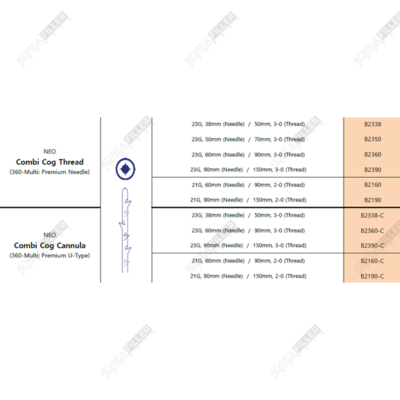
| B2160 | 21G · 60 mm needle · 90 mm thread · USP 2-0 |
| B2190 | 21G · 90 mm needle · 150 mm thread · USP 2-0 |
| B2338 | 23G · 38 mm needle · 50 mm thread · USP 3-0 |
| B2350 | 23G · 50 mm needle · 70 mm thread · USP 3-0 |
| B2360 | 23G · 60 mm needle · 90 mm thread · USP 3-0 |
| B2390 | 23G · 90 mm needle · 150 mm thread · USP 3-0 |
| Material | Polydioxanone (PDO) |
| Barb configuration | 360° multi-directional cogs |
| Delivery | Pre-loaded in a sharp premium needle |
| Placement plane | Deep subcutaneous / muscular |
| Pack size | 20 pieces per pack |
| Sterilisation | Sterile, single use only |
| Storage | Room temperature, dry, away from sunlight |
Checking the pack
- The model code matches your order — B2338, B2350, B2360 and B2390 differ only in needle length.
- Each blister is intact and dry. A breached sterile barrier makes that unit waste.
- The expiry date is clear. PDO hydrolyses with moisture.
- The pack holds 20 pieces.
Sharp needle, not a cannula. This product places directly without a separate entry port — but it also cuts rather than displaces, so bruising is higher than with our Cog Cannula. Choose accordingly for patients who cannot show downtime.
What each component does
What “360-Multi” means
Barbed threads differ in how the cogs are cut into the filament, and the pattern decides how the thread behaves.
- Two-plane barbing — cogs cut on opposite faces. Effective, but grip depends on the thread lying in the right orientation. A thread that rotates during insertion engages less well than one that does not.
- 360° multi-directional — cogs cut around the full circumference. Engagement is the same whichever way the thread sits, so rotation during placement stops mattering.
The trade-off is that cutting barbs all round removes more material from the filament, so a 360-barbed thread needs a sound base thickness to retain tensile strength. That is why this product sits at USP 2-0 and 3-0 — heavier than the smooth threads in the range, not lighter.
Reading the specifications
- 21G and 23G — needle diameter; higher number means thinner. Heavier than mono thread needles because a barbed filament needs more bore.
- Needle vs thread length — the filament always extends beyond the needle so it stays in tissue as the needle withdraws. A 60 mm needle carries 90 mm of thread.
- USP 2-0 and 3-0 — filament thickness on the standard suture scale, where more zeros means thinner. 2-0 is the heavier of the two.
How to use NEO Combi Cog threads
Reference information for practitioners already trained in barbed thread technique. Deep placement with a sharp needle demands confident anatomical knowledge — you are working near vessels and nerves with a cutting tip and no tactile warning.
Step by step
-
Plan vectors with the patient upright
Mark entry points and vectors before the patient lies down. A vector planned supine does not deliver what you discussed in the mirror.
-
Prepare and anaesthetise
Thorough antisepsis — this is an implant. Local anaesthetic at entry points and along the tracks; topical alone is insufficient at 21G and 23G.
-
Enter and find the plane
Enter at the marked point and advance to the deep subcutaneous or muscular plane. This thread is designed to engage substantial tissue, so superficial placement both under-performs and risks visibility.
-
Advance along the vector
Maintain consistent depth along the full track. Because the barbs engage from any angle, you do not need to control rotation — but you do need to control plane.
-
Withdraw the needle, leave the thread
Hold the thread steady and withdraw the needle along the same track. The barbed filament stays in tissue.
-
Redrape and assess sitting up
Redrape tissue gently along the vector to seat the barbs, then sit the patient up and check symmetry before treating the other side.
-
Trim flush
Trim protruding thread at skin level with tissue in its neutral position, so the end retracts below the surface.
Administration notes
Plane discipline is the whole technique here. A 360-barbed thread removes the need to control rotation, which is genuinely helpful — but it does nothing to forgive a thread placed too superficially. Too shallow and you get dimpling and visible tracks; too deep and the barbs find nothing to hold.
Sharp needle means more bruising. A cutting tip travelling 60 to 90 mm through the subcutaneous plane will catch vessels that a blunt cannula would have pushed aside. If downtime is the patient’s main constraint, our Cog Cannula is the better choice for that case.
- Single use. Never re-sterilise or reuse a thread or needle.
- Do not place across active infection, recent filler, or previous permanent implant.
- Avoid dragging barbs against packaging or instruments — damaged cogs cost you the grip you are paying for.
- Dispose of needles into a sharps container per local clinical waste requirements.
After treatment
- Swelling, bruising and a pulling sensation are expected for one to two weeks; bruising is typically more pronounced than with cannula threads
- Minimal facial movement for two weeks — no wide yawning, big smiles or tough food
- Sleep on the back, head elevated, for the first week
- No facial massage, facials or dental work for three to four weeks
- No saunas, steam rooms or strenuous exercise for two weeks
- Review at two weeks. Spreading redness, increasing pain, discharge or visible thread extrusion needs seeing promptly
Storing and handling NEO Combi Cog threads
Store at room temperature in a dry place, away from direct sunlight. No refrigeration, no cold chain.
Each unit is individually sealed and sterile. Do not use any whose blister is open, torn, damp or damaged. Never re-sterilise — autoclaving destroys PDO.
360° cogs are cut around the full circumference, which makes them more exposed than two-plane barbs. Avoid dragging the thread against packaging or instruments when loading.
Single use only. Do not reuse, re-sterilise or repackage. Dispose of used needles into a sharps container and unused product as clinical waste in line with local requirements.
What's included
Each pack contains one size only. Antiseptic, local anaesthetic, marking pen and sharps disposal are not supplied. No separate entry needle is needed — this product places directly through its own sharp needle.
NEO Combi Cog Thread — frequently asked questions
What is a Combi Cog thread?
A polydioxanone thread with barbs cut around the full 360° circumference of the filament, pre-loaded in a sharp needle. The barbs grip subcutaneous tissue, which lets the thread hold tissue in a repositioned place.
What does "360-Multi" mean in practice?
Cogs are cut all the way round the thread rather than on two faces only. Because of that, engagement does not depend on the thread’s rotation — it grips the same whichever way it ends up sitting after insertion.
With two-plane barbing, a thread that rotates during placement engages less well. The 360 pattern removes that variable.
How does this compare to your Cog Cannula?
Both are barbed PDO threads that reposition tissue. The differences are delivery and barb pattern.
Combi Cog uses a sharp needle and 360° barbs — faster placement, no separate entry port, more bruising. Cog Cannula uses a blunt tip and bi-directional barbs — less bruising and lower vascular risk, but it needs an entry port made with a sharp needle first.
If downtime is the patient’s main concern, the cannula. If placement speed matters more, this one.
Why is a lifting thread this thin?
It is designed as a thin thread placed deep, at the muscular plane, where the tissue it engages is substantial enough to hold despite the finer filament. USP 2-0 and 3-0 are still considerably heavier than the 5-0 to 7-0 used for smooth threads.
Will this treat a double chin?
No, and the earlier version of this listing was wrong to suggest it. Submental fullness is usually fat, and no thread removes fat.
What a thread can do is reposition lax tissue along the jawline, which sharpens the jaw angle and can improve the submental contour as a consequence. That is a different thing from treating a double chin, and worth describing accurately at consultation.
Which size do I choose?
Match thread length to vector length. The 38 mm and 50 mm needles suit short midface vectors; 60 mm covers most jawline work; the 90 mm needle carrying 150 mm of thread spans a full jawline or longer midface vector in one pass.
The 21G options are the heavier filament at USP 2-0 — more holding power, more bulk.
How long does the result last?
The PDO hydrolyses over roughly six months, so the mechanical support is temporary. The collagen laid down around the thread persists beyond that, which is why the result does not simply disappear with the material.
Duration varies widely with tissue, thread count and technique, so assess at review rather than promising a figure.
Do they need refrigeration?
No. Room temperature, dry, out of direct sunlight — no cold chain to manage.
What if the patient dimples afterwards?
Dimpling along a track usually means the thread sits too superficially, or the tissue was redraped too hard. Mild cases often settle within one to two weeks. Persistent or marked dimpling needs reviewing in person.
Who can buy and use these?
Barbed threads are sterile implantable medical devices and carry a higher risk profile than smooth threads. They require specific training in vector planning, plane control and barbed thread technique. We supply to practitioners qualified to perform the procedure in their jurisdiction, and do not sell to consumers.

Copyright 2026 © Korea Filler Experts. All right reserved.
