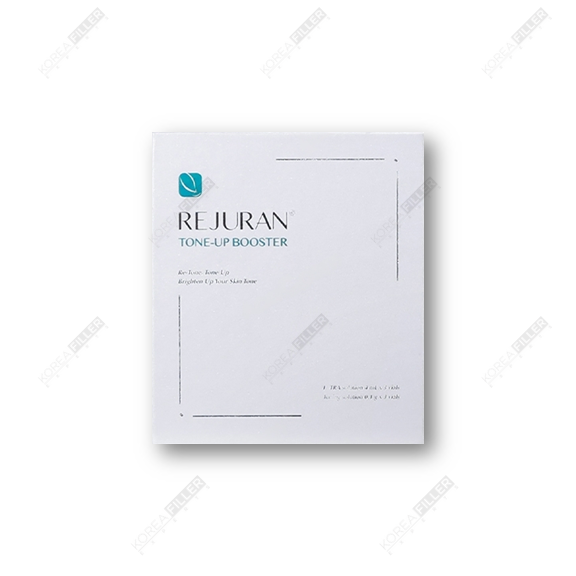
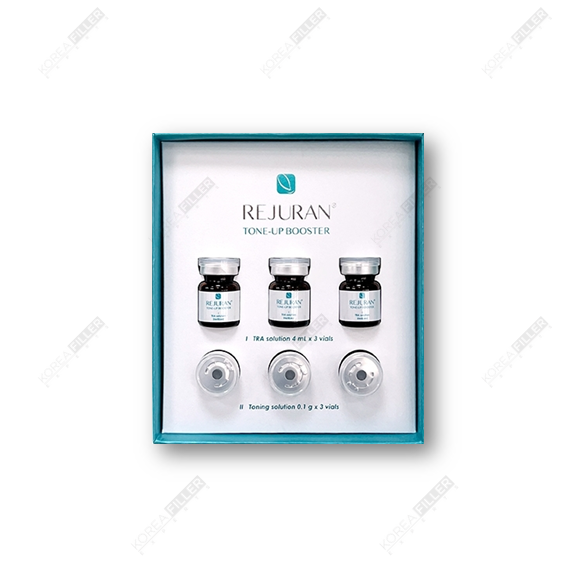
Rejuran Tone-Up Booster
Two-part topical system · PDRN toning solution plus vitamin C, glutathione and tranexamic acid · for post-microneedling and post-laser application. Not an injectable.
$133.90
Rejuran Tone-Up Booster is a two-part topical system pairing PDRN-based toning with a Vitamin C and glutathione brightening solution, designed for post-microneedling or laser application.
Professional use only. This product is intended for administration by licensed healthcare practitioners trained in the relevant anatomy and injection technique. By ordering you confirm you are authorised to purchase and handle products of this class in your jurisdiction. Availability and permitted use vary by country — please verify local regulations before ordering.
Did you like this product? Add to favorites now and follow the product.

(+82) 10 7364 7998 Send a message on WhatsApp.
A two-vial topical system for skin tone, applied after resurfacing
Rejuran Tone-Up Booster is a topical two-part system from PharmaResearch, designed to be mixed at the chairside and applied immediately after microneedling (MTS) or fractional laser.
The first vial carries hydrolysed DNA (c-PDRN) with sodium hyaluronate and panthenol — the conditioning and hydrating component. The second carries ascorbic acid, glutathione and tranexamic acid, three ingredients that act on different points in the pigment pathway. Mixed together and applied through freshly opened channels, the system addresses skin tone and surface quality in the same appointment as the resurfacing procedure.
Two things to be clear about. This is a topical formulation, not an injectable — it is applied to the skin, never injected. And while the formula targets uneven tone, outcomes vary considerably with the patient’s skin, the underlying cause of their pigmentation, and sun exposure afterwards. It supports a tone-directed protocol; it is not a standalone answer to pigmentation.
Hydrolysed DNA (c-PDRN), sodium hyaluronate and panthenol. The hydrating and skin-conditioning component.
Ascorbic acid, glutathione and tranexamic acid, acting at different points in the pigment pathway.
Applied to the skin surface after a barrier-opening procedure. This is not injectable glutathione.
Adds a tone-directed step to a microneedling or laser treatment you are already performing.
Why practitioners stock Tone-Up Booster
Ascorbic acid, glutathione and tranexamic acid act at different points in melanin production rather than duplicating one another.
Applied while microneedling or laser channels are still open, when absorption of actives is at its highest.
Turns a resurfacing appointment into a combination protocol without new equipment or additional chair time.
A topical route to these actives, which sidesteps the regulatory complications attached to injectable glutathione in many markets.
Applications
Uses for a tone-directed topical applied after a barrier-opening procedure. Outcomes vary with the cause of the pigmentation, the patient’s skin type and their sun exposure. Permitted claims and indications vary by market — check what applies where you practise.
Added to a microneedling or fractional laser appointment to address tone in the same session. The primary use, and the one the two-part design is built around.
Where the complaint is a tired, flat complexion rather than discrete pigmentation. The antioxidant and conditioning components are most relevant here.
Diffuse unevenness from accumulated sun exposure. Responds more predictably than hormonally driven pigmentation — though sun protection afterwards still determines whether it holds.
Tranexamic acid has a documented role in melasma. Melasma is chronic, recurrent and notoriously difficult, so this belongs within a broader managed protocol rather than as a standalone answer.
This is a topical product for professional use alongside a resurfacing procedure. Which applications and claims are permitted is determined by the regulatory framework where you practise, and several markets regulate pigmentation-related claims specifically. Korea Filler Experts supplies the product; nothing here is a recommendation to treat any medical condition, and nothing here should be presented to patients as a guaranteed outcome.
What is inside Rejuran Tone-Up Booster
| Vial 1 | Hydrolysed DNA (c-PDRN), sodium hyaluronate, panthenol |
| Vial 2 | Ascorbic acid, glutathione, tranexamic acid |
| Preparation | Mix the two vials immediately before use |
| Application | Topical, following MTS or fractional laser |
| Injectable? | No — this product is not for injection |
| Manufacturer | PharmaResearch, South Korea |
| SKU | 08037 |
Before you order
- Confirm you want a topical. This is not an injectable, and it is not comparable to injectable glutathione.
- Check lot number and expiry on the carton against both vials.
- We do not dispatch stock with under 6 months of shelf life remaining unless agreed in advance.
- Store as stated on the carton, protected from light. Ascorbic acid in particular degrades on light exposure.
Mix only at the point of use. The two vials are supplied separately for stability reasons — combining them in advance defeats the design.
What each component does
What each active does
Described by mechanism rather than by promised outcome, because outcomes in pigmentation vary enormously with cause, skin type and sun behaviour.
- Ascorbic acid (vitamin C) — an antioxidant that also inhibits tyrosinase, the rate-limiting enzyme in melanin synthesis. It is unstable in solution, which is part of why this system is mixed immediately before use rather than supplied pre-combined.
- Glutathione — an endogenous antioxidant. It is understood to influence the balance between eumelanin and the lighter pheomelanin, and to inhibit tyrosinase indirectly. Most of the published work concerns oral and intravenous routes; evidence specifically for topical application is more limited.
- Tranexamic acid — originally an antifibrinolytic, with a well-documented role in melasma. It is understood to act by interfering with the plasmin pathway that links UV exposure and keratinocyte signalling to melanocyte activation. It has the strongest published base of the three in pigmentary conditions.
- c-PDRN, sodium hyaluronate, panthenol — the conditioning side: supporting the dermal matrix, binding water, and soothing freshly resurfaced skin.
Topical, not injectable — and why that distinction matters
Injectable glutathione marketed for skin purposes is restricted, unapproved or explicitly warned against by regulators in a number of markets, including on safety grounds. Several national authorities have issued statements about it.
Tone-Up Booster is not that product. It is a topical formulation applied to the skin surface after a resurfacing procedure, and it should never be injected. If a patient or a supplier asks you about “glutathione injections”, this is a different thing entirely, and the distinction is worth making clearly.
What governs the result
Pigmentation responds to the cause, not just to the actives applied. Melasma driven by hormonal factors behaves differently from post-inflammatory pigmentation, which behaves differently again from simple photodamage.
And in every case, sun protection does more than any topical. A patient who leaves without daily SPF will undo a tone-directed protocol faster than the protocol can work. That is the single most useful thing to tell them.
How to use Rejuran Tone-Up Booster
Reference information for licensed practitioners. This product is applied topically and must not be injected. Technique must follow the manufacturer’s instructions for use and the regulations applying where you practise.
Step by step
-
Assess the pigmentation first
Melasma, post-inflammatory pigmentation and photodamage respond differently and need different protocols. Establish which you are treating before planning a course.
-
Cleanse thoroughly
Full cleansing and antisepsis before the resurfacing procedure. You are about to open the barrier, and whatever is on the skin goes in with the product.
-
Perform the resurfacing step
Microneedling or fractional laser to your usual protocol and depth. Be conservative in deeper skin types, where aggressive settings raise post-inflammatory pigmentation risk.
-
Mix the two vials
Combine immediately before application. Ascorbic acid is unstable in solution, which is why the system is supplied as two parts rather than premixed.
-
Apply evenly across the area
Distribute with gentle even pressure, or continue device passes per your protocol. Uneven application shows as patchy tone, which is the opposite of the goal.
-
Leave in place and protect
Do not cleanse off. Send the patient away with explicit sun-protection instructions — this is the step that determines whether the protocol holds.
Administration notes
Never inject this product. It is a topical formulation. If you are asked about injectable glutathione, note that it is restricted or unapproved for skin purposes in a number of markets and that this is not the same thing.
Post-inflammatory hyperpigmentation is the risk worth naming. Applying a tone-directed protocol to freshly resurfaced skin in a patient with a deeper skin type carries a real possibility of the resurfacing itself triggering the pigmentation you were treating. Conservative device settings, careful patient selection and uncompromising sun protection all matter more here than the formula does.
Set honest expectations. Pigmentation is slow to shift, prone to recurrence, and heavily influenced by factors outside the treatment room. A course of several sessions with strict daily SPF is the realistic framing; a single session producing a visible change is not.
- Single use. Mix fresh for each patient and discard any remainder.
- Do not apply over active infection, inflamed skin or open lesions beyond the controlled channels of the procedure.
- Ask about fish allergy — the c-PDRN component is DNA-derived.
- Follow your resurfacing device’s own protocol for depth and passes.
After treatment
- Redness and a warm, tight sensation are expected after resurfacing and typically settle within 24 to 48 hours
- No cleansing, make-up or active skincare for the rest of the day
- Daily broad-spectrum SPF is non-negotiable — it does more for the result than the treatment does
- Avoid direct sun exposure and all sunbed use
- Avoid saunas, steam rooms, swimming and strenuous exercise for 48 hours
- Avoid retinoids and acids for several days
- Any spreading redness, increasing pain or new darkening of the treated area needs reviewing
Storing and handling Tone-Up Booster
Store as stated on the carton and in the manufacturer’s insert, protected from light. Ascorbic acid degrades on light exposure, so this matters more here than for most products.
The two-part presentation exists for stability. Mix only at the point of use — a premixed solution loses potency before you get to the patient.
Use immediately. Do not retain mixed solution for a later appointment or another patient.
For topical use only — do not inject. Do not use if either solution is discoloured or contains visible particles, if the expiry date has passed, or if a seal is broken. Discoloration in the ascorbic acid component is a sign of oxidation. Dispose of unused product as clinical waste in line with local requirements.
What's included with Tone-Up Booster
Microneedling device or laser is not supplied — this product works with equipment you already have. Mix the two vials only at the point of use.
Rejuran Tone-Up Booster — frequently asked questions
What is Rejuran Tone-Up Booster?
A two-part topical system from PharmaResearch. Vial 1 contains hydrolysed DNA (c-PDRN), sodium hyaluronate and panthenol; vial 2 contains ascorbic acid, glutathione and tranexamic acid. The two are mixed at the chairside and applied immediately after microneedling or fractional laser.
Is this injectable glutathione?
No, and the distinction matters. This is a **topical** formulation applied to the skin surface after a barrier-opening procedure. It must never be injected.
Injectable glutathione marketed for skin purposes is restricted, unapproved or the subject of regulatory warnings in a number of markets, including on safety grounds. Tone-Up Booster is a different product with a different route, and conflating the two would be a mistake.
What do the three actives in vial 2 do?
They act at different points in melanin production rather than duplicating each other.
**Ascorbic acid** is an antioxidant that also inhibits tyrosinase, the rate-limiting enzyme in melanin synthesis. **Glutathione** is an endogenous antioxidant understood to influence the balance between darker and lighter melanin types. **Tranexamic acid** interferes with the plasmin pathway linking UV exposure to melanocyte activation, and has the strongest published base of the three in pigmentary conditions.
Why are the two vials supplied separately?
Stability. Ascorbic acid is unstable in solution and degrades over time and on light exposure, so the system is supplied as two parts and mixed immediately before use.
Premixing in advance defeats the design — you lose potency before the product reaches the patient.
What results should I promise a patient?
Be careful here. Pigmentation responds to its cause as much as to the actives applied — melasma, post-inflammatory pigmentation and photodamage all behave differently, and recurrence is common.
The honest framing is a course of several sessions as part of a tone-directed protocol, with daily sun protection doing as much work as the treatment. A single session producing a visible change is not a realistic promise.
Is it safe for patients with deeper skin types?
It needs more care, and the risk comes from the resurfacing rather than the formula. Microneedling and laser in deeper skin types carry a real possibility of triggering post-inflammatory hyperpigmentation — the very thing you are treating.
Conservative device settings, careful patient selection and uncompromising sun protection matter more here than the product does.
How does it differ from Trueskin Essence?
Both are topicals applied after a resurfacing procedure. Trueskin Essence is a single PN formula aimed at recovery and skin conditioning.
Tone-Up Booster is a two-part system that adds the vitamin C, glutathione and tranexamic acid complex, aimed at skin tone rather than recovery alone.
Can it be applied without microneedling or laser?
Penetration would be limited. The system is designed around a procedure that temporarily opens the barrier — that is what allows the actives to reach tissue where they can act.
Applied to intact skin, you are largely treating the surface.
How often should it be used?
In line with your resurfacing protocol, typically every two to four weeks as a course. Pigmentation work is slow, so plan and quote the full course at consultation rather than selling it session by session.
Who can buy and use this product?
This product is intended for use by trained practitioners alongside a resurfacing procedure. We supply to professionals qualified to perform those procedures in their jurisdiction, and do not sell to consumers.

Copyright 2026 © Korea Filler Experts. All right reserved.
